


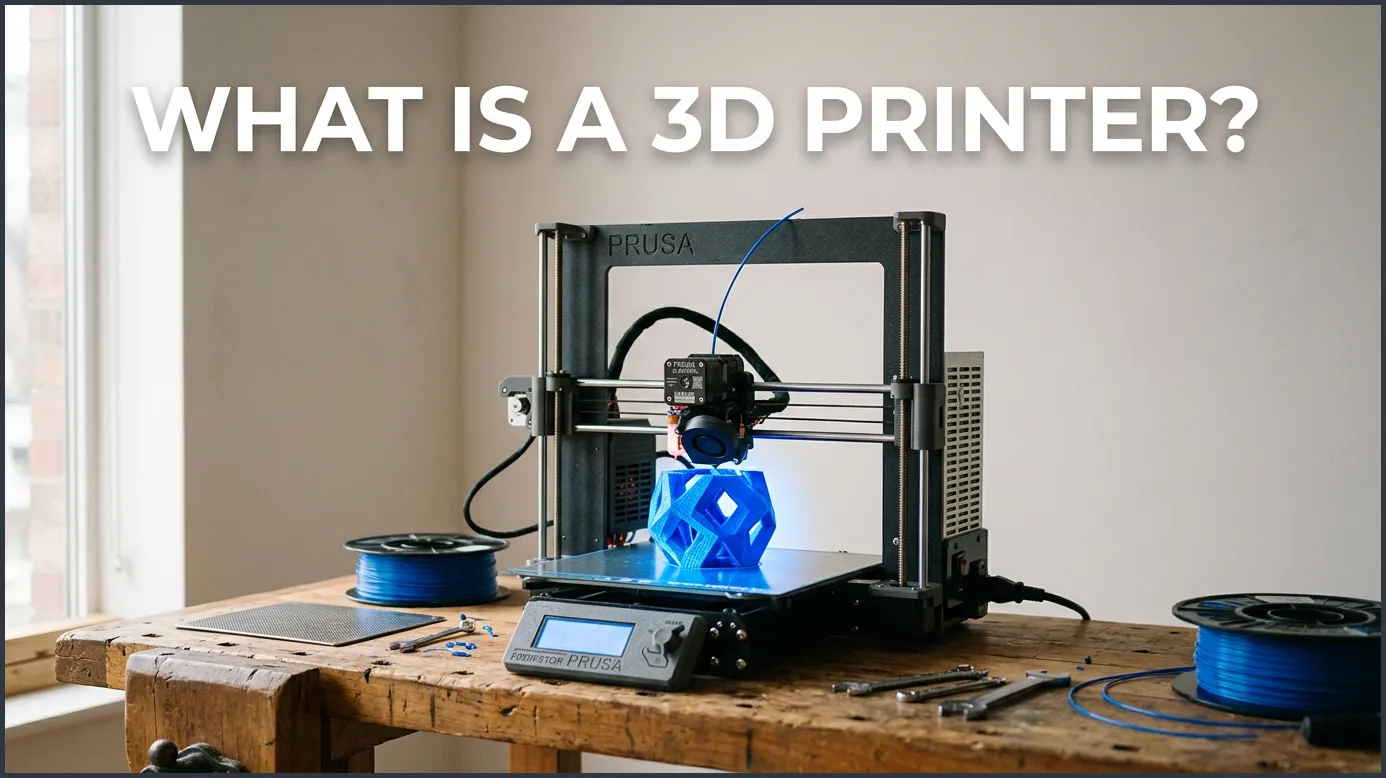
A 3D printer is an innovative machine that creates physical, three-dimensional objects from a digital design file. By building items layer by layer, these devices allow you to manufacture everything from simple household toys to complex medical devices right from your desk. It is a game-changing technology that bridges the gap between digital creativity and physical reality.
Imagine you are working on a weekend DIY project. You suddenly realize you are missing a small, specific plastic bracket. In the past, you would have to drive to the hardware store, search the aisles, and hope they had it in stock. If they did not, your project was stuck. Today, a single desktop machine can solve that exact problem in less than an hour.
You simply find a file online, press a button, and watch a physical object appear out of thin air. This magic happens thanks to a technology that is rapidly changing our world. But how does this technology actually fit into our daily lives, and how does it work?
In this guide, we will explore the inner workings of these fascinating machines. We will look at how they turn digital ideas into real objects, the different types available, and the best materials to use. Whether you are a curious hobbyist or looking to start a new business, this article will cover everything you need to know to get started.
Key Takeaways
- Additive Manufacturing: Unlike traditional carving methods, 3D printers build objects from the ground up, adding material layer by layer.
- Digital Blueprints: Every print starts as a digital file, which a program called a slicer cuts into thin horizontal instructions.
- Diverse Technologies: The most common technologies include FDM (which melts plastic filament) and SLA (which uses liquid resin and light).
- Wide Range of Materials: Users can print with plastics like PLA and ABS, flexible rubbers, carbon fiber, resins, and even metals.
- Infinite Uses: Applications range from home DIY repairs and custom toys to aerospace engineering and life-saving medical devices.
- Accessible and Affordable: High-quality desktop printers are now highly affordable, making the hobby accessible to beginners.
Quick Answers to Common Questions
What materials can a 3D printer use?
Most desktop 3D printers use plastics like PLA and ABS, while professional machines can print with liquid resin, nylon, carbon fiber, and even metals.
How long does it take to print a 3D object?
Printing times vary from a few minutes for tiny items to several hours or even days for large, highly detailed models.
Is 3D printing difficult for beginners to learn?
No, modern 3D printers and user-friendly software have made the learning curve very manageable for beginners.
How much does a beginner 3D printer cost?
You can find reliable, entry-level FDM 3D printers for anywhere between $150 and $300.
Do I need to know how to code to use a 3D printer?
No, you do not need to code because slicing software automatically generates the instructions your printer needs.
📑 Table of Contents
The Magic Behind the Machine: How It Works
At first glance, watching a 3D printer can feel like watching science fiction. A nozzle moves back and forth, leaving a trail of plastic that slowly rises into a solid shape. To truly understand this technology, we must look at how it translates digital code into physical form.
From Digital Blueprint to G-code
Every 3D print starts life as a digital 3D model on a computer. You can design this model yourself using special software, or you can download a pre-made design from the web. Once you have your design, you must run it through a program called a slicer.
The slicer cuts your virtual model into hundreds or thousands of thin, horizontal layers. It then translates these layers into a language the printer can understand, called G-code. This G-code acts as a highly detailed map. It tells the printer exactly where to move, how fast to go, and how much material to release.
The Layer-by-Layer Building Process
Once the printer receives the G-code, the physical work begins. Traditional manufacturing is usually subtractive. This means you start with a big block of wood or metal and carve away what you do not need, creating a lot of waste.
A 3D printer does the exact opposite. It uses additive manufacturing. The printer starts with a blank build plate and adds material one thin layer at a time. Each new layer fuses to the one below it. For a deeper look at this mechanical process, you can read more about how does a 3D printer work. Step by step, the machine stacks these ultra-thin layers until a complete, solid object is formed.
The Main Types of 3D Printers You Need to Know
Not all 3D printers are the same. They use different technologies and materials to achieve the final result. While there are many industrial types, three main technologies stand out for everyday use.
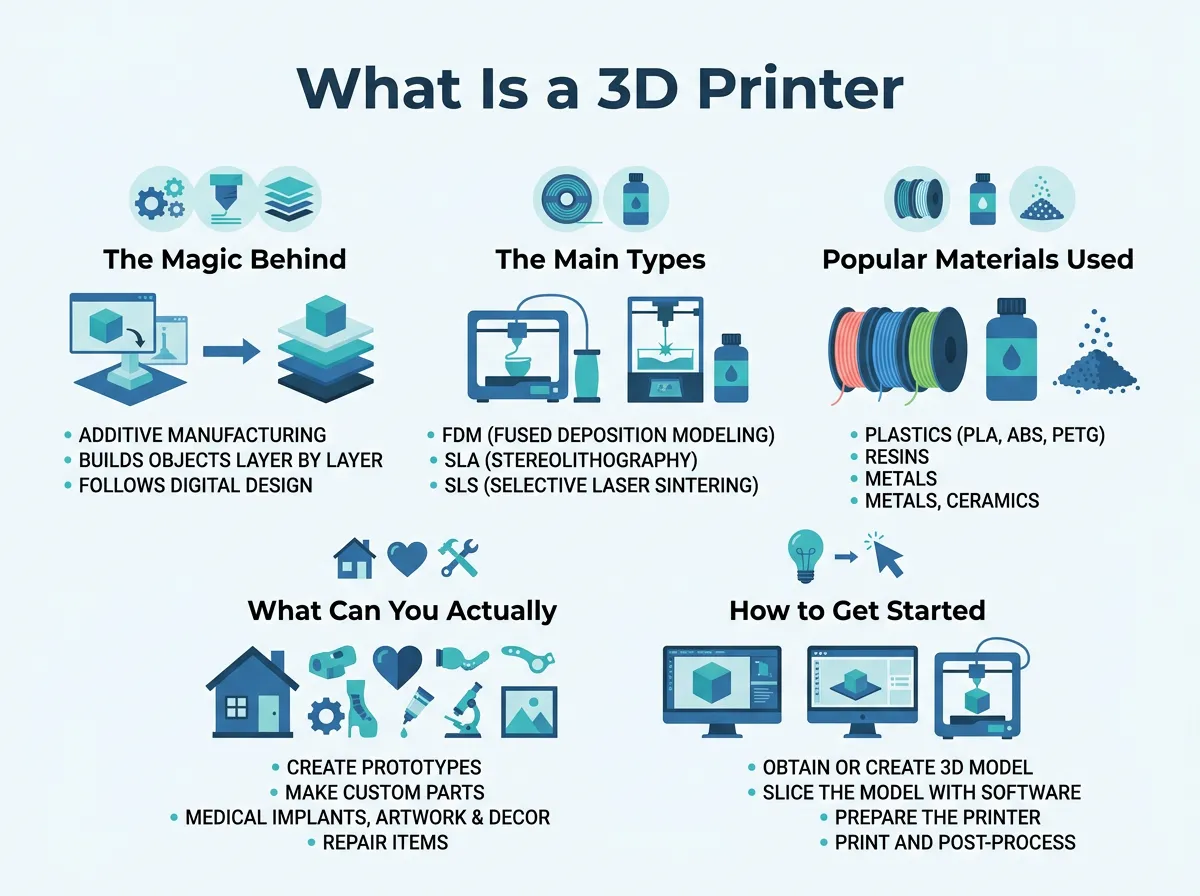
What Is a 3D Printer? — key points at a glance
FDM (Fused Deposition Modeling)
FDM is the most common and affordable type of 3D printing. If you have seen a 3D printer in a school, library, or home workshop, it was almost certainly an FDM machine.
These printers use spools of solid plastic wire called filament. The printer feeds this filament into a hot nozzle, which melts the plastic. The printer then draws the shape of each layer on the build plate with the melted plastic. The plastic cools and hardens almost instantly. FDM printers are great for beginners, easy to use, and highly cost-effective.
SLA (Stereolithography)
SLA printers work in a very different way. Instead of melting plastic wire, they use a liquid pool of light-sensitive resin. A laser or light projector shines into the liquid, curing and hardening it layer by layer.
SLA printers are famous for creating objects with incredible detail and perfectly smooth surfaces. They are highly popular among jewelry makers, dentists, and miniature modelers. For professional-grade results, many experts rely on highly precise SLA 3D printers to capture every tiny detail.
SLS (Selective Laser Sintering)
SLS is an industrial technology that uses a powerful laser to fuse tiny particles of powder together. Usually, this powder is made of nylon.
The laser heats the powder just below its melting point, drawing the shape of each layer. Because the object is surrounded by unsintered powder during the build, it does not need any temporary support structures. This allows designers to create highly complex shapes that would be impossible to make with any other printing method.
Popular Materials Used in 3D Printing
The material you choose has a major impact on how your print looks, feels, and performs. Let us look at the most common options available today.
PLA and ABS Plastics
PLA (Polylactic Acid) is the undisputed king of 3D printing filaments. It is made from natural sources like cornstarch, which makes it safe and easy to use at home. It prints at low temperatures, does not smell bad, and comes in almost every color imaginable.
ABS (Acrylonitrile Butadiene Styrene) is the same tough plastic used to make LEGO bricks. It is much stronger and more heat-resistant than PLA. However, it requires a heated printer bed and good ventilation, as it can release smelly fumes during printing.
Resins and Flexible Filaments
If you want flexible parts, you can use TPU (Thermoplastic Polyurethane). This rubber-like material lets you print phone cases, gaskets, and shoe soles that can bend and flex without breaking.
Liquid resins, used in SLA printers, offer different benefits. Some resins are designed to be tough, while others are castable, making them perfect for creating metal jewelry molds.
What Can You Actually Make with a 3D Printer?
The list of things you can create is almost endless. To understand the true power of this technology, it helps to look at a few practical examples.
Fun Hobbies and Home Upgrades
For home users, 3D printing is a portal to endless creativity. You can print missing board game pieces, custom storage organizers, or beautiful plant pots. If something breaks around the house, you can often design and print a replacement part in an afternoon. Many people also use them to print detailed action figures, cosplay armor, and custom artistic home decor.
Industrial and Medical Breakthroughs
Outside the home, 3D printing is saving lives and transforming industries. Doctors use them to print custom prosthetics that fit patients perfectly. Dentists use them to print dental crowns and clear teeth aligners.
In the aerospace industry, engineers print lightweight metal parts for rocket engines. You can explore a complete history of 3D printing to see how this technology evolved from a niche prototyping tool into a massive manufacturing revolution.
How to Get Started with Your First 3D Printer
Getting into 3D printing is easier and cheaper than ever before. Here is a simple plan to help you take your first steps into this exciting hobby.
Choosing the Right Machine
If you are a complete beginner, start with an FDM printer. They are cheap, easy to maintain, and safe to use. Look for a printer with a large online community. Having a big community means you can easily find help, upgrades, and troubleshooting tips when you need them.
Finding and Designing 3D Models
You do not need to be a master 3D designer to start printing. Websites like Thingiverse and Printables host millions of free 3D models created by users worldwide. You can simply download these files and start printing.
If you want to design your own objects, start with free, easy-to-use software like Tinkercad. It uses basic shapes to help you learn the fundamentals of 3D design without feeling overwhelmed.
Conclusion
At its core, a 3D printer is a tool that turns your imagination into reality. By building physical objects layer by layer, it puts the power of manufacturing directly into your hands. From printing small household fixes to creating highly complex industrial prototypes, this technology is shaping our future. Now that you know the basics, the only question left is: what will you print first?
Frequently Asked Questions
What is the difference between FDM and SLA printers?
FDM printers melt plastic filament layer by layer and are great for basic models. SLA printers use a UV laser to cure liquid resin, resulting in much higher detail and smoother surfaces.
Are 3D printed objects food safe?
Generally, most raw 3D prints are not food safe because tiny gaps between layers can trap bacteria. To make them safe, you must coat them with a food-grade epoxy seal.
Can a 3D printer print metal?
Yes, industrial 3D printers can print metal using lasers to melt metal powder layer by layer. However, these machines are very expensive and are typically used in aerospace and medical manufacturing.
Where can I find free designs for my 3D printer?
You can find millions of free, ready-to-print designs on websites like Thingiverse, Printables, and MyMiniFactory. Users worldwide upload their creations to these platforms for anyone to download.
Is 3D printing an expensive hobby?
It has become very affordable over the last few years. While high-end machines cost thousands, entry-level printers are cheap, and a standard one-kilogram spool of filament costs around $20.
Do 3D printers emit harmful fumes?
Some materials, like PLA, release very little odor and are safe for home use. Others, like ABS or liquid resin, can emit harmful fumes and require a well-ventilated room or a dedicated air filtration system.
