


Starting a successful 3D printing business requires choosing a profitable niche, investing in the right printers, and mastering 3D design software. By targeting specific industries like medical prototyping, custom gaming minis, or spare parts, you can build a highly profitable venture from home. With a solid marketing plan and a focus on quality, you can easily turn your passion for printing into a thriving, scalable business.
Imagine waking up in the morning, grabbing a warm cup of coffee, and walking into your spare room. There, a row of machines is quietly buzzing away. They are turning digital ideas into physical, high-value products while you sleep. Every single layer of plastic or resin they lay down is helping you build a real, cash-flowing company. This is not a distant dream. It is the daily life of many modern makers who decided to learn how to start a 3D printing business.
The world of additive manufacturing is growing incredibly fast. What used to be a hobby for tech enthusiasts has now become a powerful manufacturing tool. Today, small businesses can compete with giant factories right from their kitchen tables. If you have ever wanted to run your own shop, make your own products, and enjoy the freedom of working for yourself, this guide is for you. We will walk through every single step to get your new venture up and running.
Starting a new company can feel a bit overwhelming at first. You might worry about the cost of machines, the complexity of the software, or how to find paying customers. Do not worry. We will break down the entire process into simple, easy-to-follow steps. By the end of this article, you will have a clear roadmap to launch your very own workshop.
Key Takeaways
- Find a Niche: Target specific markets like medical, tabletop gaming, or vintage car parts to stand out from the competition.
- Choose the Right Gear: Pick FDM printers for strong, functional parts and SLA resin printers for fine, high-detail items.
- Master the Software: Learn CAD design and slicing tools to control your production quality and customize orders.
- Price for Profit: Calculate filament costs, power, machine wear, and your personal labor time to set sustainable prices.
- Start Small: Begin from home to keep your overhead low, then reinvest your profits to buy more machines and scale.
Quick Answers to Common Questions
Do you need a license to sell 3D printed items?
You do not need a special printing license, but you must register your business locally and ensure you have the commercial rights to sell any 3D files you did not design yourself.
Is a 3D printing business highly profitable?
Yes, it can be highly profitable if you focus on a specific niche like prototyping or custom hobby items where markup margins can exceed 300 percent.
What is the best 3D printer for beginners starting a business?
An FDM printer like the Bambu Lab P1S or Creality Ender series is perfect for beginners because they are reliable, affordable, and easy to maintain.
How much does it cost to start a 3D printing business?
You can easily start from home with a budget of 500 to 1,000 dollars, which covers your first quality printer, initial filament rolls, and basic design software.
Can you sell 3D prints of other people’s designs?
You can only sell prints of other people’s designs if the designer has granted a commercial license, which is often available through platforms like Patreon or Thangs.
📑 Table of Contents
1. Find Your Profitable 3D Printing Niche
One of the biggest mistakes new business owners make is trying to print everything for everyone. If you offer a generic printing service, you will end up competing with cheap online factories. To build a highly profitable business, you need to find a specific niche. A niche is a small, focused part of the market that has unique needs. When you specialize, you become the go-to expert for those specific buyers.
Custom Prototyping for Local Businesses
Many local inventors, engineers, and small businesses need physical models of their designs. They do not want to wait weeks for overseas shipping. You can offer fast, local prototyping services. This allows them to hold their design in their hands within 24 hours. Since these clients are businesses, they have bigger budgets and are willing to pay a premium for speed and clear communication.
Personalized Consumer Goods
People love items that are custom-made just for them. You can print personalized items like custom cake toppers, custom gaming miniatures, or unique jewelry. For example, the tabletop gaming community is massive and loves detail. Printing high-quality, custom-designed hero figures for board games can easily become a full-time job. You can sell these items on platforms like Etsy or at local craft fairs.
2. Choosing the Right 3D Printing Equipment
Once you know what you want to make, you need to buy the right tools. You do not need to spend thousands of dollars on industrial machines to start. You can begin with one or two reliable desktop printers and buy more as your orders grow. There are two main types of printers you should consider for your new business.
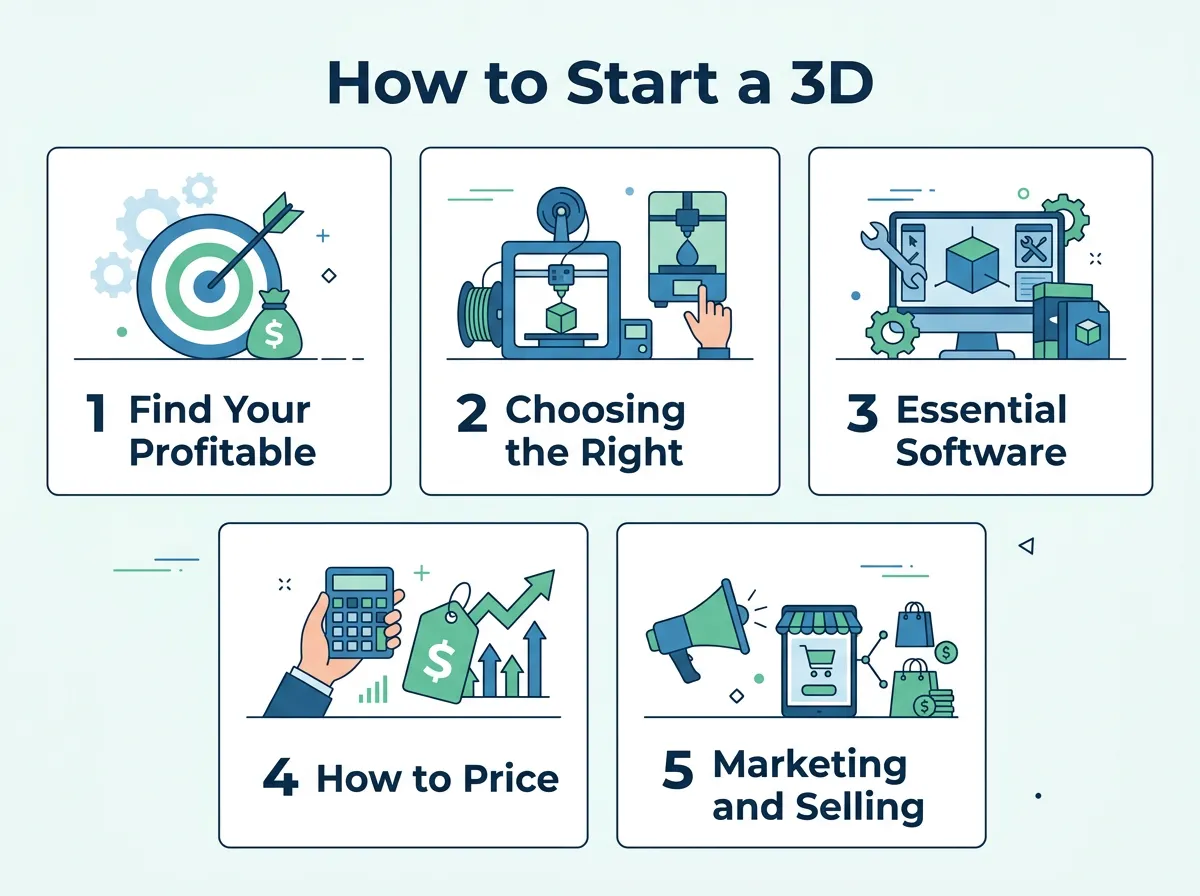
How to Start a 3D Printing Business? — key points at a glance
FDM Printers (Fused Deposition Modeling)
FDM printers are the most common machines on the market. They work by melting a plastic wire, called filament, and squeezing it through a hot nozzle to build an object layer by layer. These printers are excellent for making strong, functional parts, large items, and prototypes. Popular materials include PLA for easy printing, PETG for outdoor use, and ABS or Nylon for super strong parts. FDM printers are safe to run in a home office and have very low material costs.
SLA Resin Printers (Stereolithography)
SLA printers use a UV laser or light screen to harden liquid resin into solid plastic. These machines offer incredible detail and smooth surfaces. They are perfect for making jewelry, dental models, and highly detailed miniatures. However, resin printing requires more work. You must wear gloves, wash the finished prints in alcohol, and cure them under UV light. You also need a well-ventilated space to handle the fumes safely.
3. Essential Software and Design Tools
To run your business, you need to know how to talk to your machines. This means using software to prepare your digital files for printing. You do not need to be a computer genius, but you do need to practice using these tools daily.
CAD Design Software
If you can design your own unique products, you will make much more money than someone who just prints other people’s files. Computer-Aided Design (CAD) software allows you to create 3D models from scratch. Programs like Fusion 360 or Onshape are fantastic for functional parts and engineering designs. For organic shapes, like characters or art, tools like Blender or ZBrush are the industry standards. Many of these programs offer free versions for beginners.
Slicing Software
A slicer is the software that translates your 3D model into code that your printer can understand. It cuts your model into thin horizontal layers and plans the path for the print head. Popular slicers like Cura, PrusaSlicer, or Bambu Studio are free and very easy to use. Learning how to adjust settings like infill density, layer height, and print speed will save you time and prevent wasted material.
4. How to Price Your 3D Printed Products
Pricing is where many new owners get confused. If you price your items too low, you will work long hours for very little money. If you price them too high, customers will buy from someone else. When learning how to start a 3D printing business, you must build a smart pricing formula that covers all your costs and guarantees a profit.
Calculating Material and Machine Costs
First, figure out the cost of the raw materials used for the print. Slicing software will tell you exactly how many grams of plastic or milliliters of resin a print requires. Next, add a small fee for electricity and machine wear. Printers do not last forever, so you need to save a small amount from every print to pay for maintenance and spare parts.
Accounting for Labor and Overhead
Your time is valuable. You must charge for the time you spend setting up the printer, cleaning the finished parts, packing the orders, and talking to clients. Finally, add your profit margin. A good rule of thumb for retail products is to multiply your total production cost by three. For custom design work, you should charge a flat hourly rate for your design time on top of the print cost.
5. Marketing and Selling Your Services
You can have the best printers in the world, but you will not make any money if nobody knows you exist. You need to actively promote your services and find your ideal buyers. Thankfully, the internet makes it easier than ever to reach people all over the world.
Building an Online Presence
Start by setting up a clean, professional website. You can use simple platforms like Shopify or Squarespace to showcase your work and accept payments. If you want to sell physical products directly to consumers, open an Etsy shop. Etsy already has millions of buyers looking for unique, handmade items. Use high-quality photos with bright, clean lighting to show off the fine details of your prints.
Local Networking and Social Media
Do not forget about your local community. Visit local maker markets, comic book shops, or engineering firms. Hand out your business cards and bring physical samples of your work. Let people touch and feel the quality of your prints. On social media, post short videos of your printers in action on TikTok and Instagram. People love watching the printing process, and these videos can easily go viral, bringing in tons of free traffic to your store.
6. Managing Quality and Scaling Your Business
As your business grows, you will face new challenges. Managing quality and keeping customers happy is key to your long-term success. You want your buyers to leave glowing reviews and recommend you to their friends.
Always inspect every single print before you pack it up. Check for rough layers, stringing, or weak spots. If a print is not perfect, do not ship it. Redo the print. It is much cheaper to spend a few cents on extra plastic than to lose a customer over poor quality. As you get more orders, reinvest your profits to buy faster machines. Having a fleet of identical printers allows you to print multiple orders at the same time, making your business much more efficient.
Conclusion
Learning how to start a 3D printing business is an exciting journey. It combines creativity, technology, and entrepreneurship into one amazing side hustle or full-time career. You do not need a giant warehouse or a million dollars to begin. By choosing a smart niche, picking the right entry-level machines, and pricing your work fairly, you can build a highly profitable business right from your own home. Take it one step at a time, keep learning, and start printing your path to success today!
Frequently Asked Questions
Can I start a 3D printing business from my home?
Yes, absolutely. Most successful 3D printing entrepreneurs start their businesses in a spare bedroom, basement, or garage to save on rent. You just need a sturdy table, a reliable power source, and proper ventilation for resin printers.
How do I calculate the cost of a 3D print?
To find the cost, use your slicing software to see the exact weight of the plastic used, then calculate its cost based on your spool price. Add the cost of electricity per hour, a small amount for machine wear, and your target hourly rate for labor.
Which is better for a business: FDM or resin printing?
It depends entirely on what you plan to sell to your target market. FDM is best for sturdy, functional parts and large items, while resin is ideal for small, highly detailed items like jewelry and miniatures.
Do I need to know CAD design to start?
While you can start by printing commercially licensed designs from other artists, knowing CAD design is a huge advantage. Creating your own unique files allows you to solve custom problems and charges much higher design fees.
How do I protect my original 3D designs?
You can protect your unique 3D designs by watermarking your product images and filing for copyright protection. When sharing digital files online, use reputable platforms that offer secure viewing and clear commercial licensing terms.
What are the most profitable things to 3D print?
The most profitable items are highly customized or rare functional parts, such as replacement gears, personalized wedding decor, custom cosplay armor, and architectural models. These items solve specific problems, allowing you to charge premium prices.
