


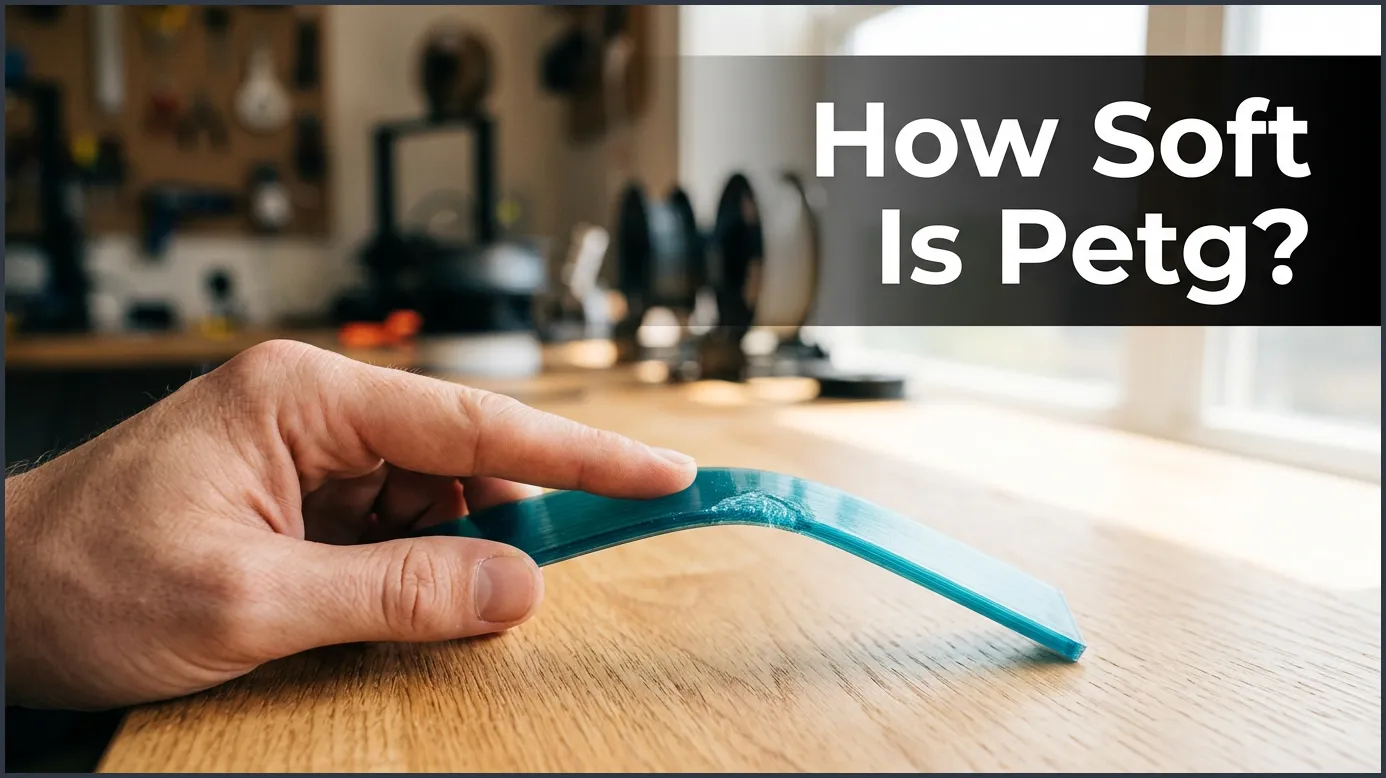
PETG is not soft like rubber or silicone; instead, it is a semi-rigid thermoplastic that balances strength with a slight amount of bend. While it feels hard to the touch and resists scratches well, it is less brittle than PLA, allowing it to flex under pressure without snapping. This unique blend of rigidity and mild flexibility makes it highly durable for functional 3D prints.
Imagine you are holding a plastic water bottle in your hand. You squeeze it. It yields slightly to your grip, but it does not crack or shatter. That bottle is made of PET, the close cousin of PETG. If you are new to 3D printing, you might wonder how this material translates to your printed parts. Is your final print going to feel like a hard rock, or will it have some squish to it?
When choosing a filament for your next project, understanding the feel of the material is key. You do not want to print a protective phone case only to find out it is as stiff and brittle as glass. At the same time, you do not want a mounting bracket that bends like warm butter. Today, we will dive deep into the physical feel, stiffness, and hardness of PETG.
We will look at how it compares to other popular filaments. We will also explore how heat and moisture can change its texture. By the end of this guide, you will know exactly what to expect when your printer finishes a PETG run. Let’s find out how soft this popular plastic really is.
Key Takeaways
- Semi-rigid nature: PETG is a firm plastic, not a soft, rubbery elastomer like TPU.
- Flexible but tough: It bends slightly under stress instead of snapping, making it less brittle than PLA.
- High impact resistance: Its mild flexibility allows it to absorb shocks and drops extremely well.
- Temperature limits: PETG softens at around 80°C, so it is not suitable for high-heat environments.
- Scratch resistant: It has a glossy, hard surface that resists daily wear and tear.
Quick Answers to Common Questions
Is PETG softer than PLA?
Yes, PETG is slightly softer and more flexible than PLA. While PLA is very rigid and brittle, PETG can bend under pressure without snapping.
Can you scratch PETG easily?
PETG is moderately scratch-resistant, but it is softer than glass or metal. It can get scuffed by sharp objects, though it resists daily wear better than softer plastics like TPU.
At what temperature does PETG start to soften?
PETG starts to soften at its glass transition temperature, which is around 80°C (176°F). Above this temperature, the material loses its structural shape and becomes rubbery.
Is PETG soft enough to use for rubber seals?
No, PETG is a semi-rigid plastic and is too hard to be used as a rubber seal. For flexible, watertight seals, you should use a TPU or TPE filament instead.
Does moisture make PETG prints soft?
Moisture does not make PETG rubbery, but it degrades the material during printing, leading to brittle layers and weak parts. Always dry your filament to keep its structural strength intact.
📑 Table of Contents
Understanding PETG Hardness and Texture
To answer the question, how soft is PETG, we first need to look at its surface. PETG is a thermoplastic polyester. It is not soft like silicone, rubber, or TPU. If you tap a solid PETG block on a wooden table, it will make a sharp, clacking sound. It is a solid, tough plastic that does not compress when you squeeze it between your fingers.
Shore Hardness of PETG
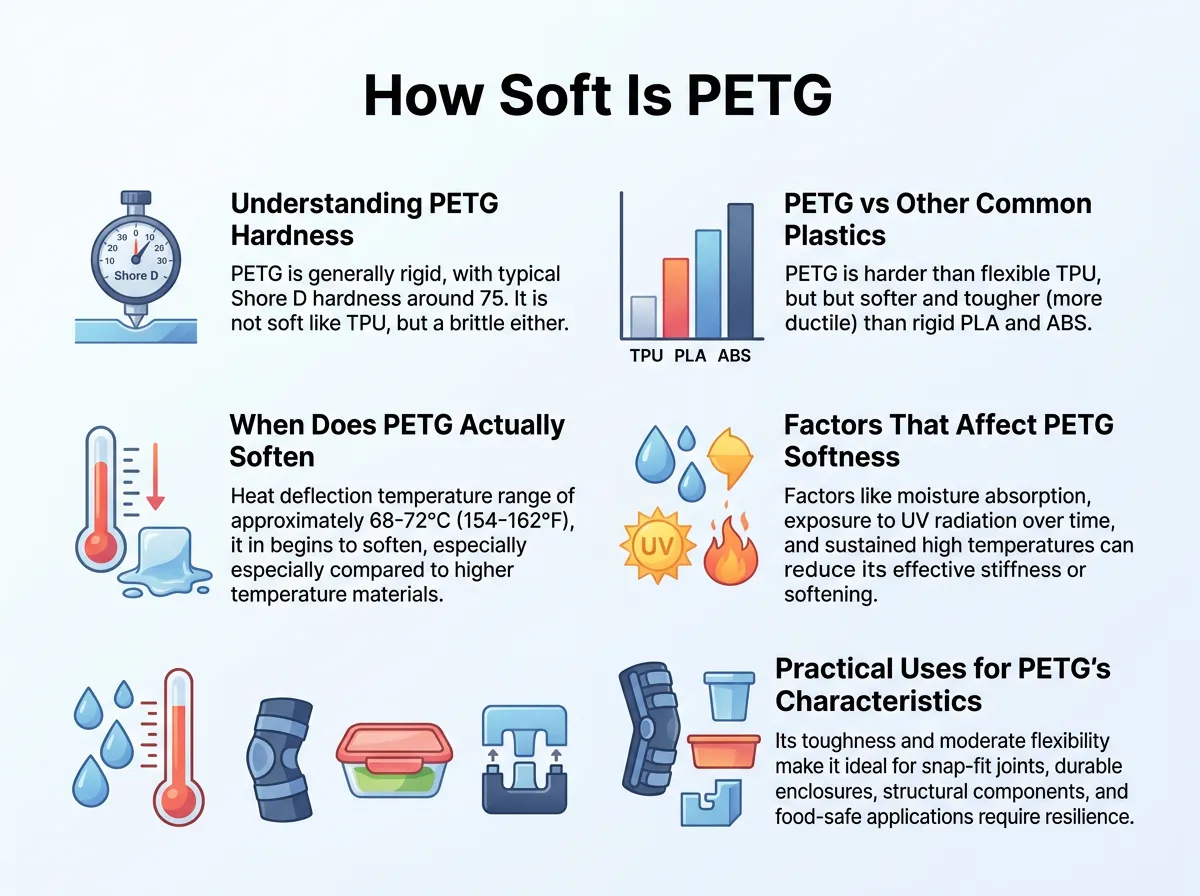
In the world of materials science, we measure the hardness of plastics using the Shore scale. Soft rubbers and flexible plastics are measured on the Shore A scale. Hard, rigid plastics use the Shore D scale. PETG sits high on the Shore D scale, usually rating around 80D. For context, a hard hat, a golf ball, or a hard skateboard wheel has a similar rating. This means its surface is highly resistant to dents, scratches, and daily wear.
The Touch Test: How It Feels in Your Hand
If you hold a printed PETG part, it feels smooth, solid, and slightly glossy. It does not have a soft, rubbery grip or a velvety texture. It feels very similar to an acrylic sheet or a heavy-duty plastic food container. However, if you print a thin sheet of PETG, you will notice something cool. It can bend quite a bit before it breaks. This is where its reputation for “softness” or elasticity comes from.
PETG vs. Other Common 3D Printing Filaments
To get a better idea of where PETG stands, it helps to compare it directly to materials you might already know.
How Soft Is PETG? — key points at a glance
PETG vs. PLA: Rigid vs. Brittle
PLA is the most popular 3D printing filament in the world. It is very hard and highly rigid. However, PLA is also quite brittle. If you bend a thin piece of PLA, it snaps with a loud crack. PETG is slightly less rigid than PLA. If you bend a thin piece of PETG, it will flex instead of snapping. According to the Simplify3D PETG guide, this material offers a fantastic middle-ground. It gives you the stiffness you need for structure, but adds enough impact resistance to keep parts from shattering.
PETG vs. TPU: Semi-Rigid vs. Rubber-Soft
TPU is a truly soft filament. You can squish it, stretch it, and twist it like a rubber band. PETG is nothing like TPU. You cannot squeeze a solid PETG part to deform it. If you want a soft, rubbery phone case that absorbs vibrations like a cushion, TPU is your best bet. If you want a tough case that can take a drop but still holds its shape firmly, PETG is the clear winner.
When Does PETG Actually Get Soft?
While PETG is hard at room temperature, it does not stay that way forever. Heat plays a major role in how soft this plastic becomes.
The Glass Transition Temperature
Every plastic has a glass transition temperature. This is the exact point where the plastic shifts from a hard, glassy state to a soft, rubbery state. For PETG, this temperature is around 80°C (176°F). This is much higher than PLA, which softens at 60°C. However, it is lower than ABS, which can handle over 100°C. You can read more about the heat deflection properties of PETG to see how it performs under physical loads.
Real-World Heat Exposure
What does this mean for everyday use? If you leave a PLA print in a hot car on a summer day, it will warp and melt. A PETG print will usually survive. However, if you use it near a car engine, inside a hot oven, or in dishwasher cycles, it will fail. On online communities, many Prusa forum users discuss PETG softening when exposed to warm enclosure temperatures. Always keep your target environment in mind before printing.
Factors That Affect PETG Softness and Flexibility
Not all PETG prints feel the exact same. You can change how soft or flexible a finished part feels by adjusting a few factors in your slicer or workspace.
Print Settings and Infill Density
If you print a part with 100% infill and many outer walls, it will feel rock hard. If you lower the infill to 10% and use a gyroid pattern, the part will have some give. You can also change the number of wall loops. Fewer walls make the part more flexible. More walls make it stiffer. This lets you customize the mechanical properties of your model.
Moisture and Wet Filament
PETG is highly hygroscopic. This means it loves to absorb moisture from the air. Wet PETG prints poorly, causing stringing and bubbles. It can also lead to weaker layer bonding. While wet filament does not make the plastic “soft” like rubber, it makes the structural integrity soft. This causes the print to split easily under pressure. Always store your rolls in a dry box to keep them in peak condition.
Practical Uses for PETG’s Balanced Hardness
Because PETG is not too stiff and not too soft, it is the Goldilocks material for many practical projects.
Snap-Fit Joints and Living Hinges
Have you ever printed a plastic clip that broke the very first time you used it? That was likely printed in PLA. PETG is perfect for snap-fit joints. It can bend outward to slide over a ridge and then snap back into place without breaking. This mild flex is highly useful for box lids, battery covers, and mounting clips.
Protective Cases and Brackets
If you need to mount a camera on a drone or a bicycle, you want PETG. It is hard enough to hold the camera steady. Yet, it is soft enough to absorb the vibrations of the road or motors. It will not crack if your drone has a rough landing on grass.
Tips for Printing to Maximize or Minimize Softness
Here are a few quick tips to help you get the exact feel you want from your PETG prints:
- For more flex: Use thin walls (2 perimeters) and low infill (10-15%). Print with a slightly lower temperature to keep the plastic rigid but elastic.
- For maximum stiffness: Increase your wall count to 4 or more. Use an infill of 40% or higher. Grid or triangles infill patterns add a lot of internal stiffness.
- Keep it dry: Dry your PETG at 65°C for 4-6 hours before printing. This ensures the polymer chains bond perfectly, giving you maximum strength and preventing brittle failures.
Conclusion
So, how soft is PETG? The simple answer is that it is not soft to the touch, but it is highly flexible under pressure. It is a tough, semi-rigid material that fills the gap between brittle PLA and rubbery TPU. It offers great impact resistance, stands up to scratches, and can survive warm days inside a car. By tweaking your slicer settings, you can easily control how much your PETG parts bend. It is a fantastic tool for any 3D maker’s toolkit.
Frequently Asked Questions
Can PETG be used for outdoor parts?
Yes, PETG is highly suitable for outdoor use. It has great UV resistance and handles heat better than PLA, meaning it won’t warp under direct sunlight.
Is PETG food safe?
PETG is naturally food-safe, and many water bottles are made from it. However, 3D printed parts have tiny gaps that can harbor bacteria, so you should coat them with a food-safe sealant before use.
Why does my PETG print bend so much?
Your print is likely thin or has a low infill percentage. To make it stiffer, you should increase the wall thickness and use a denser infill pattern in your slicer.
Is PETG easy to print?
PETG is relatively easy to print, but it can be prone to stringing and oozing. It requires a heated bed and higher printing temperatures than PLA to get good results.
Does PETG warp like ABS?
No, PETG warps much less than ABS. It does not require a heated enclosure, making it much easier to print on open-frame 3D printers.
Can I use PETG for gears?
Yes, PETG can be used for light-duty gears because of its wear resistance and mild flexibility. However, for high-load or high-wear gears, nylon is usually a better choice.
