


A starter 3D printer typically costs between $150 and $400, while professional machines can range from $1,500 to over $10,000. However, the true cost includes ongoing expenses like filament, resin, replacement parts, and electricity. Understanding these extra costs helps you choose the perfect printer for your budget.
Imagine being able to create almost anything you want right from your desk. You could make a custom phone stand, a missing board game piece, or even a replacement part for your broken sink. This is the magic of 3D printing. It is no longer a futuristic dream. Today, anyone can buy a machine and start making things at home.
But before you jump into this exciting world, you likely have one big question on your mind: how expensive is a 3D printer? It is a very fair question. The price tag on the box is only part of the story. Like buying a car, there are upfront costs and ongoing costs. If you are asking yourself how expensive is a 3D printer, you will find that the answer varies widely depending on your goals.
In this article, we will break down the true cost of 3D printing. We will look at different price tiers, explore hidden fees, and give you some handy tips to save money. By the end, you will know exactly what to expect before you spend your hard-earned cash.
Key Takeaways
- Entry-level printers: Great for beginners and cost between $150 and $400.
- Mid-range printers: Offer better reliability and cost between $400 and $1,500.
- Hidden expenses: Materials, electricity, and spare parts add to the long-term price.
- FDM vs. Resin: FDM printers are cheaper to run, while resin printers offer higher detail at a slightly higher cost.
- Maintenance: Regular care saves money by preventing expensive part replacements.
Quick Answers to Common Questions
Can I get a good 3D printer for under $200?
Yes, there are several reliable entry-level FDM printers available for under $200 that are perfect for beginners.
Is resin printing more expensive than filament printing?
Resin printing is generally more expensive due to higher material costs and the need for extra safety gear and cleaning supplies.
How much does 3D printer filament cost?
A standard one-kilogram roll of PLA filament typically costs between $20 and $30.
Does running a 3D printer use a lot of electricity?
No, most home 3D printers use about as much electricity as a standard desktop computer or a small refrigerator.
Are there free programs for 3D printing?
Yes, popular slicing software like Cura and PrusaSlicer are completely free to download and use.
📑 Table of Contents
The Cost Spectrum: From Hobbyist to Industrial
You can find 3D printers at many different price points. The right one for you depends on what you want to make and how often you will use it.
Entry-Level Hobbyist Printers ($150 – $400)
If you are new to this world, you do not need to spend a fortune. Entry-level printers are amazing for beginners. They are cheap, easy to find, and have huge communities online. You can easily find a great starter printer for under $250. These machines are perfect for learning the basics. You will learn how to level the print bed, load material, and fix basic issues.
Mid-Range and Enthusiast Printers ($400 – $1,500)
Do you want something that works right out of the box with less tinkering? If so, mid-range printers are a great choice. These machines offer better print quality and faster speeds. They also come with helpful features like auto-bed leveling, touchscreens, and Wi-Fi connectivity. They are built with stronger frames, which means they last longer and need fewer repairs.
Professional and Industrial Printers ($1,500 – $10,000+)
For businesses, schools, or serious designers, professional printers are the way to go. These machines can print with advanced materials like carbon fiber or nylon. They are highly reliable and can run non-stop for days. While a home printer might cost a few hundred dollars, industrial systems can go much higher as detailed in this overview of 3D printer cost factors.
Types of 3D Printers and Their Costs
Not all 3D printers work the same way. The technology inside the machine also changes the price tag significantly.
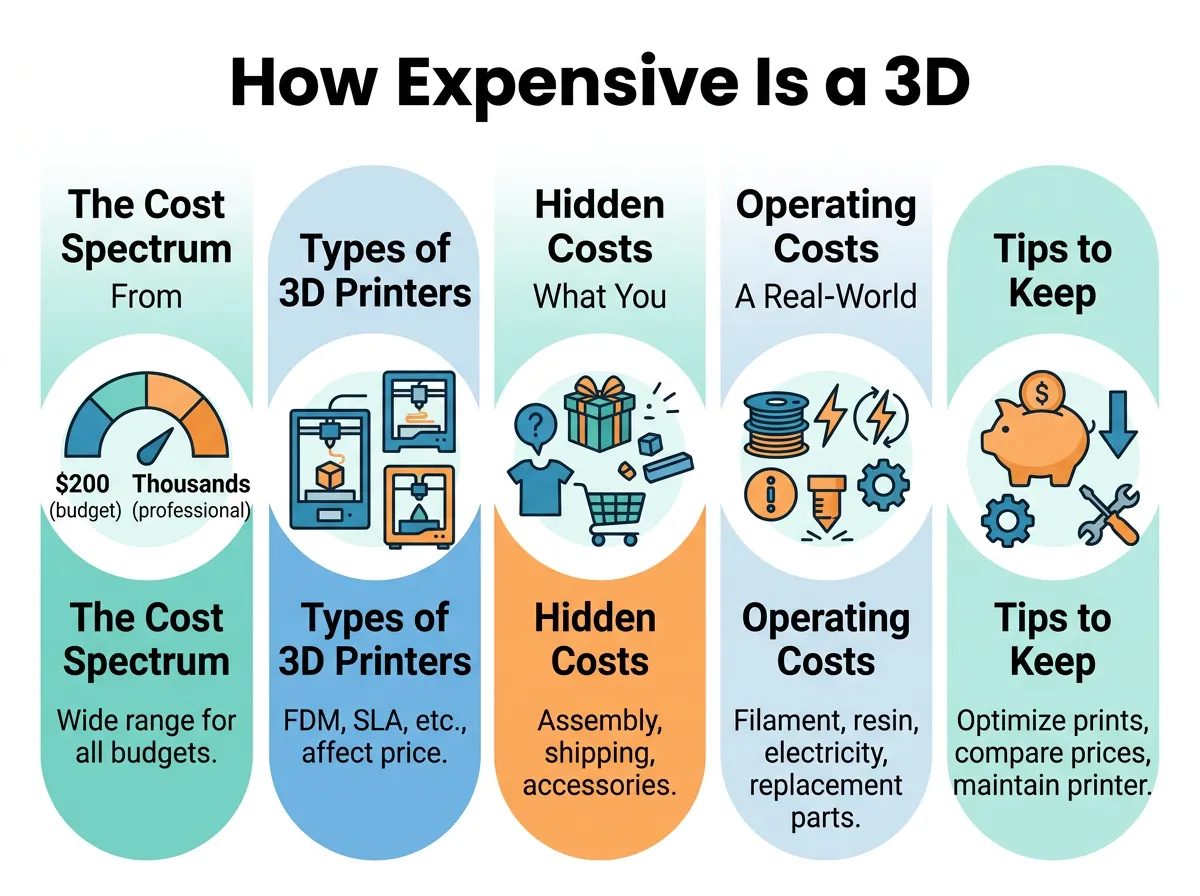
How Expensive Is a 3D Printer? — key points at a glance
FDM (Fused Deposition Modeling)
FDM printers are the most common type. They work by melting a plastic string, called filament, and drawing layers on a flat surface. FDM printers are usually the cheapest to buy and run. If you want to know how much is a 3D printer of this style, you can find quality models starting around $200. They are perfect for big toys, tools, and sturdy parts.
SLA (Stereolithography / Resin)
SLA printers use a liquid plastic resin instead of filament. A laser or screen shines light into the liquid to harden it layer by layer. Resin printers are famous for making super-smooth objects with tiny details. They are popular for making miniature game pieces and jewelry. You can find starter resin printers for around $200 to $400. However, the liquid resin is messy and requires extra safety gear like gloves and masks.
SLS (Selective Laser Sintering) and Beyond
SLS printers are highly advanced. They use a powerful laser to melt plastic powder into solid parts. These machines do not need support structures, so you can make complex shapes. But they are very expensive. These are industrial machines that usually start at $10,000 or more. They are mostly used by factories and design studios.
Hidden Costs: What You Spend Beyond the Machine
When asking how expensive is a 3D printer, you must look past the price tag of the machine itself. There are extra costs to keep in mind to avoid surprises.
Materials (Filaments and Resins)
You cannot print without material. For FDM printers, a one-kilogram roll of PLA plastic filament costs about $20 to $30. For resin printers, a liter of liquid resin costs around $30 to $60. Depending on how much you print, you might buy a new roll every month or even every week. This is the biggest ongoing cost of the hobby.
Spare Parts and Upgrades
Parts wear out over time. You will need to replace the metal nozzle on an FDM printer occasionally. These cost only a few dollars. However, other parts like print beds, belts, or LCD screens for resin printers can cost $20 to $100. Many hobbyists also like to buy upgrades, such as better fans or quiet motors, to improve their machines.
Software and Power Usage
To print a 3D model, you need a software program called a slicer. Luckily, most of the best slicer programs are completely free. What about power? A 3D printer uses about as much electricity as a laptop or a small fridge. Running a printer for ten hours might only add a few cents to your electric bill. Still, if you run multiple machines day and night, it can add up over time.
Operating Costs: A Real-World Example
To make this easy to understand, let us look at a quick example. How much does a single printed item actually cost to make?
Printing a Simple Plastic Toy
Imagine you want to print a small plastic toy figure. It weighs about 50 grams. If your roll of filament costs $20 for 1,000 grams, the plastic for your toy costs just $1. Add a few cents for electricity, and your total cost is about $1.05. That is incredibly cheap! To plan your projects wisely, it helps to how to calculate 3D printer cost per print accurately.
Printing a High-Strength Prototype
Now imagine you need a strong part for a car engine. You need to use a high-end material like nylon. A roll of nylon filament can cost $60 or more. If the part is heavy and takes 20 hours to print, the material and power costs might be around $15 to $20. While this is more expensive, it is still much cheaper than buying a custom metal part from a machine shop.
Tips to Keep Your 3D Printing Costs Low
If you are on a tight budget, do not worry. You can keep your costs very low by following a few simple rules.
Choose the Right Materials
Stick to standard materials like PLA. It is cheap, easy to print with, and comes in many fun colors. Avoid exotic materials like wood-filled or glowing filaments unless you really need them. They cost more and can wear out your printer nozzle much faster.
Maintain Your Machine
A clean printer is a happy printer. Dust your machine, oil the moving parts, and clean the print bed after every use. This simple care keeps your parts from wearing out too fast. It also prevents failed prints, which waste valuable filament and time.
Use Free Slicing Software
You do not need to pay for high-end software. Tools like Cura or PrusaSlicer are fully free and used by professionals. They help you optimize your settings to use less plastic and print faster.
Conclusion
So, how expensive is a 3D printer? The answer depends entirely on what you want to achieve. For casual hobbyists, a starter setup can cost under $300 total, including filament. For professionals who need top-tier precision and specialty materials, the price can run into thousands of dollars.
The key is to start small. Buy a budget-friendly machine, learn the ropes, and upgrade only when you need to. 3D printing is an incredibly rewarding hobby that can actually save you money in the long run by letting you make your own custom repairs and gifts. Happy printing!
Frequently Asked Questions
What is the cheapest type of 3D printer?
FDM (Fused Deposition Modeling) printers are the most affordable option on the market. You can easily find starter models for under $200, and their plastic filament is very inexpensive.
How long does a 3D printer last?
With proper maintenance and occasional part replacements, a high-quality 3D printer can easily last for five years or more. Many key components like nozzles and belts are cheap and simple to swap out.
Is 3D printing a cheap hobby?
It can be very affordable if you stick to basic PLA filament and free design software. Once you buy the initial printer, your ongoing costs can be as low as a few dollars per month.
Do I need a computer to use a 3D printer?
Yes, you need a computer to run the slicing software that prepares your 3D designs for printing. However, you do not need an expensive computer; any standard laptop will work fine.
Why are some 3D printers so expensive?
High-end printers cost more because they offer larger build sizes, faster speeds, and better temperature control. They are also built with premium metal parts that allow them to print advanced engineering plastics.
Is it cheaper to buy or 3D print items?
For small, custom plastic parts or unique household items, 3D printing them yourself is much cheaper than buying them. However, for mass-produced items, buying them in a store is usually cheaper.
