


The cost to 3D print ranges from under $1 for small, basic plastic items to thousands of dollars for complex industrial prototypes. For home printing, you will mostly pay for the cheap raw materials like PLA filament, which costs about $20 per kilogram, plus pennies of electricity. If you outsource your prints to a professional service, expect to pay a premium for labor, machine use, and shipping.
Imagine you have a great idea for a new product. Or maybe a plastic gear in your favorite kitchen appliance just snapped. Years ago, you would have to throw the machine away or pay a machine shop hundreds of dollars to make a custom replacement part. Today, you can design and print a custom solution right from your desk. It feels like magic, but how much does it actually cost to bring these digital objects to life?
The world of 3D printing is more accessible than ever before. However, the price of making an object can still seem like a mystery. Some people will tell you it costs pennies, while others spend a small fortune on their hobby or business. We will break down every single factor that goes into the price of a print so you can plan your budget with ease.
In this guide, we will look at raw materials, energy use, and the price of the machines. We will also compare the price of printing at home versus using a professional online service. By the end, you will know exactly how to calculate and lower your print costs.
Key Takeaways
- Material Costs are Low: Standard plastic filament costs around $20 per kilogram, making small prints cost only a few cents.
- Upfront Investment: A decent entry-level home 3D printer costs between $150 and $300.
- Hidden Fees: You must account for electricity, replacement nozzle wear, and slicer software setup time.
- Outsourcing is Pricey: Professional 3D printing services charge for labor, setup, and machine time, raising costs significantly.
- Slicers Help Estimate: You can use free slicing software to find out the exact weight and cost of a print before you start.
- Resin is More Expensive: Liquid resin printing costs more than plastic filament printing but offers much higher detail.
Quick Answers to Common Questions
How much does a single 3D print cost on average?
For a home printer, most small to medium items cost between $0.50 and $3.00 in raw plastic materials.
Is it cheaper to buy a 3D printer or use a service?
If you plan to print more than ten items, buying a budget 3D printer is much cheaper than paying a professional service.
Does 3D printing use a lot of electricity?
No, most home 3D printers use very little power, costing only about 2 to 5 cents per hour of printing time.
How much does a spool of 3D printer filament cost?
A standard one-kilogram spool of PLA plastic filament costs between $18 and $25.
Can you make money with a 3D printer?
Yes, you can sell custom prints, repair parts, or artistic models on online stores to easily cover your material and machine costs.
📑 Table of Contents
The Basics of 3D Printing Costs: Home vs. Outsourcing
The very first question you need to ask is who will be running the machine. Do you want to buy your own printer, or do you want to pay someone else to do the work? This choice has the biggest impact on the question: How Much Does It Cost to 3D Print?
Buying Your Own 3D Printer
If you choose the DIY route, you have to buy a machine first. This is a one-time setup cost. A good starter printer like the Creality Ender 3 costs around $150 to $200. High-end consumer machines like a Bambu Lab printer can cost anywhere from $600 to $1,200. Once you own the machine, your ongoing cost per print drops dramatically. You only pay for the plastic you use and a tiny amount of power.
Using a 3D Printing Service
If you do not want to buy a machine, you can upload your files to a service like Shapeways or Craftcloud. They will print the object and mail it to you. This is highly convenient, but it is much more expensive per part. You are not just paying for plastic. You are paying for their expensive industrial machines, the labor to clean the print, the shipping, and their profit margin. A part that costs $1 to print at home might cost $30 or more through an online service.
Breaking Down the Direct Material Costs
When you print at home, your main ongoing expense is the raw material. How Much Does It Cost to 3D Print when we look only at the plastic or resin? It depends heavily on the quality and type of material you choose.
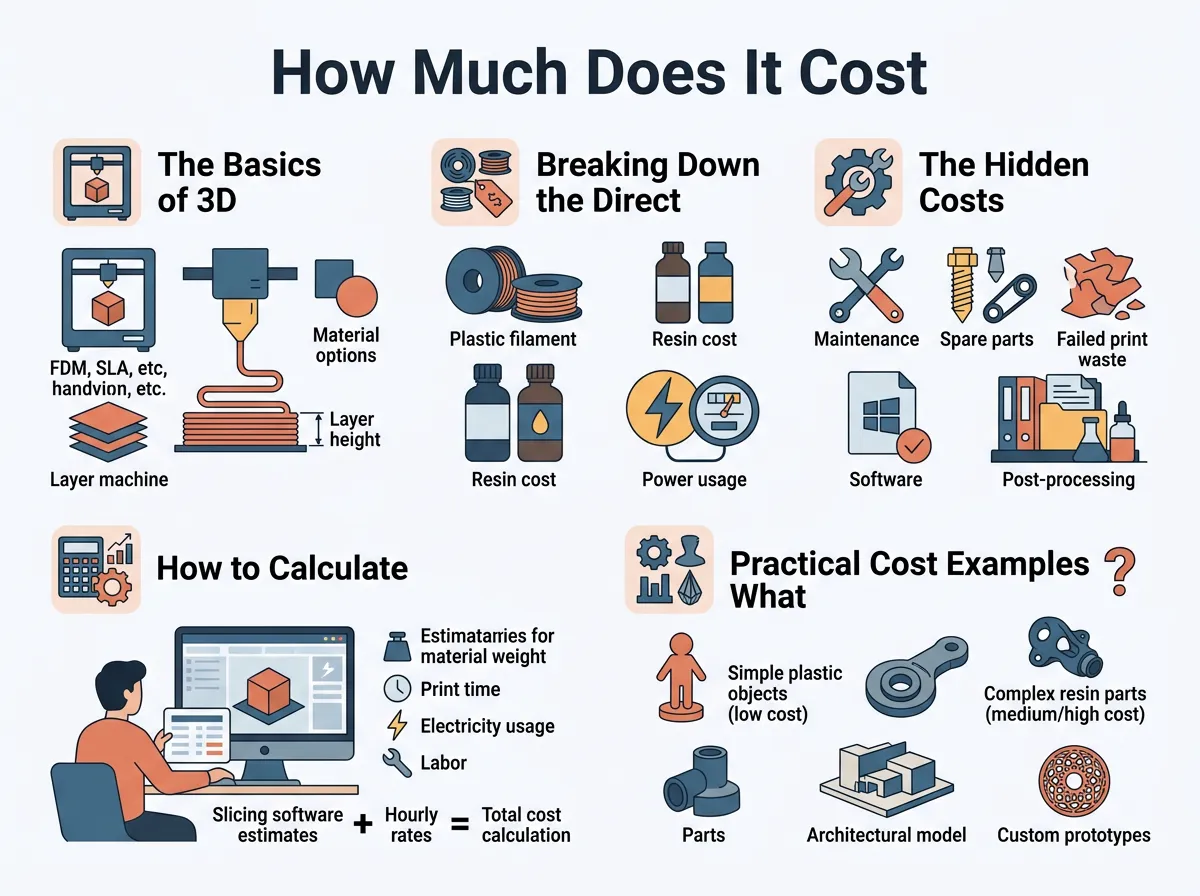
How Much Does It Cost to 3D Print? — key points at a glance
Filament Prices (FDM Printing)
FDM stands for Fused Deposition Modeling. These printers use spools of plastic wire called filament. This is the most common type of home printing. The average spool holds one kilogram (2.2 pounds) of plastic. Here is a quick look at standard filament costs:
- PLA (Polylactic Acid): This is the easiest plastic to use. A standard roll costs between $18 and $25.
- PETG (Polyethylene Terephthalate Glycol): Stronger and more heat-resistant than PLA. A roll costs $20 to $30.
- ABS (Acrylonitrile Butadiene Styrene): Tough but tricky to print. A roll costs $20 to $30.
- Specialty Filaments: Materials mixed with wood, carbon fiber, or metal. These can cost $40 to $80 per roll.
Since a standard roll of PLA costs about $20, one gram of plastic costs just 2 cents. If you print a small plastic chess piece that weighs 10 grams, the material cost is only 20 cents!
Resin Prices (SLA Printing)
SLA stands for Stereolithography. These printers use liquid resin cured by a laser or screen. Resin printing is famous for incredible detail, making it perfect for tabletop miniatures. However, liquid resin is more expensive than filament. Standard resin costs about $30 to $50 per liter. Specialty resins for dental or engineering use can cost over $150 per liter. You also need isopropyl alcohol to wash the prints, which adds to the cost.
The Hidden Costs of 3D Printing at Home
Many beginners only think about the price of plastic. But to truly understand the matter of How Much Does It Cost to 3D Print, you must look at the hidden fees. These are the small costs that add up over time.
Electricity Consumption
3D printers use heaters to melt plastic. They also use motors to move the print head. This requires electricity. Most home printers use about 100 to 300 watts of power. If you print for ten hours, you will use about 1 to 3 kilowatt-hours (kWh) of power. In the United States, the average cost of power is about 16 cents per kWh. That means a ten-hour print only costs about 16 to 48 cents in electricity. It is very cheap, but not quite free.
Machine Wear and Replacement Parts
3D printers have moving parts that wear out. Over time, you will need to replace parts. Brass nozzles get worn down by rough filaments and cost about $1 to $2 each. The build plate can lose its stickiness and cost $15 to $30 to replace. You might also need to buy grease for the rails or replace a fan. A good rule of thumb is to budget about $5 to $10 of wear-and-tear costs for every spool of plastic you finish.
Post-Processing and Software
Most slicing software is completely free. Programs like Cura and PrusaSlicer do not cost a dime. However, you might want to buy tools to clean up your prints. This includes sandpaper, hobby knives, glue sticks, and spray paint. While these are not expensive, they do add a few dollars to your hobby budget.
How to Calculate the Exact Cost of a 3D Print
You do not have to guess your costs. You can calculate them to the exact penny. Knowing the formula helps you plan your projects and price your items if you plan to sell them.
Using Slicing Software
Before you print anything, you must run your 3D file through a slicer program. The slicer cuts the digital model into flat layers for the printer. When it is done, the software will tell you exactly how many grams of plastic the print will use. Many slicers let you input the price of your spool. The program will then automatically display the exact material cost of the print.
A Simple Math Formula
If you want to do the math yourself, use this simple formula. It calculates the material cost of any print:
Material Cost = (Weight of Print in Grams) x (Cost of Spool / Weight of Spool in Grams)
For example, say you want to print a custom phone stand. Your slicer says it will weigh 50 grams. You bought a spool of PLA for $22, which weighs 1,000 grams. Your formula looks like this:
50 x ($22 / 1000) = 50 x $0.022 = $1.10
The raw material for your phone stand will cost you exactly $1.10. Add a few cents for power, and your total cost is around $1.20!
Practical Cost Examples: What Do Real Objects Cost?
To help you visualize these numbers, let us look at some common 3D printed items. This shows you how cheap printing at home can be compared to buying things at a store.
A Tabletop Gaming Miniature
A small fantasy monster or hero miniature is tiny. These usually weigh about 5 to 10 grams when printed on a resin printer. At $40 per liter of resin, a single detailed miniature only costs about 20 to 40 cents in material. Buying a similar plastic miniature at a game store often costs $5 to $10.
A Custom Phone Case
A simple, flexible phone case weighs about 30 grams. If you use flexible TPU filament, which costs about $30 per roll, the case will cost you about 90 cents to print. Buying a custom case online can cost $15 to $25.
A Large Cosplay Helmet
A full-sized Mandalorian or Stormtrooper helmet is a massive project. It can easily use a full 1,000-gram spool of PLA plastic, plus some extra for supports. With paint, sandpaper, and glue, the total cost to print a helmet at home is around $30 to $40. Buying a finished helmet online can cost $150 to $300.
Smart Tips to Lower Your 3D Printing Costs
If you print a lot, those small costs can start to add up. Luckily, there are several simple tricks you can use to lower your printing costs without losing quality.
Optimize Your Infill Settings
You do not need to print solid plastic items. Most prints use a grid pattern on the inside called infill. For most models, an infill density of 10% to 15% is plenty strong. Using less infill saves huge amounts of plastic and cuts print times in half.
Reduce Support Material
Support material is temporary plastic that holds up overhanging parts of your print. You break it off and throw it away once the print is done. This is wasted plastic. You can reduce supports by rotating your model in the slicer to find the best printing angle.
Buy Material in Bulk
If you find a brand of plastic you love, look for bulk deals. Many sellers offer discounts if you buy four or five spools at once. This can drop the price of PLA down to $14 or $15 per roll, saving you even more money in the long run.
Conclusion
So, how much does it cost to 3D print? The answer is incredibly encouraging. For the average hobbyist printing at home, the cost is shockingly low. Most everyday items cost less than a cup of coffee to make. While buying the printer itself requires some upfront money, the long-term savings and creative freedom are well worth the investment. Whether you are fixing broken toys, making custom art, or prototyping a new invention, 3D printing is one of the most cost-effective ways to bring your ideas to life.
Frequently Asked Questions
What is the cheapest material for 3D printing?
PLA (Polylactic Acid) is the cheapest and most popular material for 3D printing. It is very easy to use and typically costs around $18 to $25 for a one-kilogram spool.
How much does a 3D printer cost to buy?
Entry-level 3D printers cost between $150 and $300, which are perfect for beginners. High-end or professional machines can range from $600 to over $2,000 depending on features.
How do I calculate the weight of my 3D print?
You can find the weight of a print by loading your digital 3D model into a free slicing program like Cura. The software calculates the exact weight in grams before you start printing.
Is resin printing more expensive than filament printing?
Yes, resin printing is generally more expensive than filament printing. The liquid resin costs more per liter, and you must also buy safety gear and cleaning alcohol.
Why are 3D printing services so expensive?
3D printing services charge for labor, machine maintenance, file setup time, and shipping. They also use industrial-grade machines that cost tens of thousands of dollars to run.
Do 3D prints require expensive software?
No, you do not need expensive software to run a 3D printer. The most popular slicing programs, like Cura and PrusaSlicer, are completely free to download and use.
