


ABS filament is a strong, heat-resistant thermoplastic widely used in 3D printing to create durable, functional parts. Known as Acrylonitrile Butadiene Styrene, this plastic is ideal for making items like LEGO bricks and phone cases that need to survive daily wear and tear. While it requires a heated bed and a ventilated workspace, it remains a top choice for makers who need tough, long-lasting prints.
Imagine you are 3D printing a bracket to hold your phone on your bike. You head out on a sunny day. Suddenly, the plastic warps under the hot sun, or it snaps when you hit a bump. It is a frustrating moment that every 3D printing fan wants to avoid. That is why choosing the right plastic matters so much.
For projects that need to survive the real world, standard PLA plastic does not always cut it. You need a material that can take a beating, handle some heat, and last for years. This is where a very popular industrial plastic comes into play. It has been a staple in factories and homes for decades.
In this guide, we will dive deep into this classic material. We will look at what makes it so tough, where you see it in daily life, and how you can print it at home. We will also share simple tips to help you get perfect prints every time without the headache of warping. Let us get started!
Key Takeaways
- High Durability: ABS filament is incredibly tough, impact-resistant, and can handle daily drops and bumps.
- Heat Resistance: This material stands up to warmer temperatures much better than PLA.
- Smooth Finish: You can use acetone vapor to easily smooth out layer lines for a glossy look.
- Temperature Control: Printing with ABS requires a heated print bed and a stable environment to prevent warping.
- Proper Ventilation: ABS releases strong fumes during printing, so you must use it in a well-ventilated room or enclosure.
- Versatile Post-Processing: You can sand, paint, glue, and drill ABS prints with ease.
Quick Answers to Common Questions
Is ABS filament waterproof?
Yes, ABS plastic is naturally resistant to water and chemicals. However, water can still seep through the tiny spaces between 3D-printed layers if you do not seal them first.
Can I print ABS without a heated bed?
No, you cannot print ABS without a heated bed because the plastic will cool too quickly, warp, and peel off the build plate.
Does ABS filament smell bad?
Yes, ABS releases strong, sweet-smelling fumes that contain VOCs, so you should always print with it in a well-ventilated room.
Can you smooth ABS prints?
Yes, you can easily smooth ABS prints by exposing them to acetone vapor, which melts the outer layer to erase printing lines.
Is ABS stronger than PLA?
Yes, ABS is much tougher and more impact-resistant than PLA, meaning it will bend rather than shatter under heavy stress.
📑 Table of Contents
Understanding ABS Filament
To really get a feel for this material, we need to look at what it is made of. The letters ABS stand for three different ingredients: Acrylonitrile, Butadiene, and Styrene. Each of these parts gives the plastic a special superpower.
The Secret Recipe of ABS
Acrylonitrile gives the plastic chemical resistance and heat stability. Butadiene makes it tough and rubbery so it does not crack when dropped. Styrene gives it a shiny, hard surface that looks great. When you mix them together, you get a super plastic that can handle almost anything. This unique mix is why everything about ABS filament screams strength and utility.
A Plastic You Already Use Every Day
You probably touch ABS plastic every single day without knowing it. Have you ever stepped on a LEGO brick? That painful hardness comes from ABS. Your computer keyboard keys, your remote control, and even your car’s bumper are likely made of it. It is the go-to plastic for things that must be durable and cheap to make.
Why Choose ABS? The Key Benefits
There are many reasons why makers keep coming back to ABS filament, even with newer plastics on the market. Here are the main benefits that make it a favorite for functional parts.
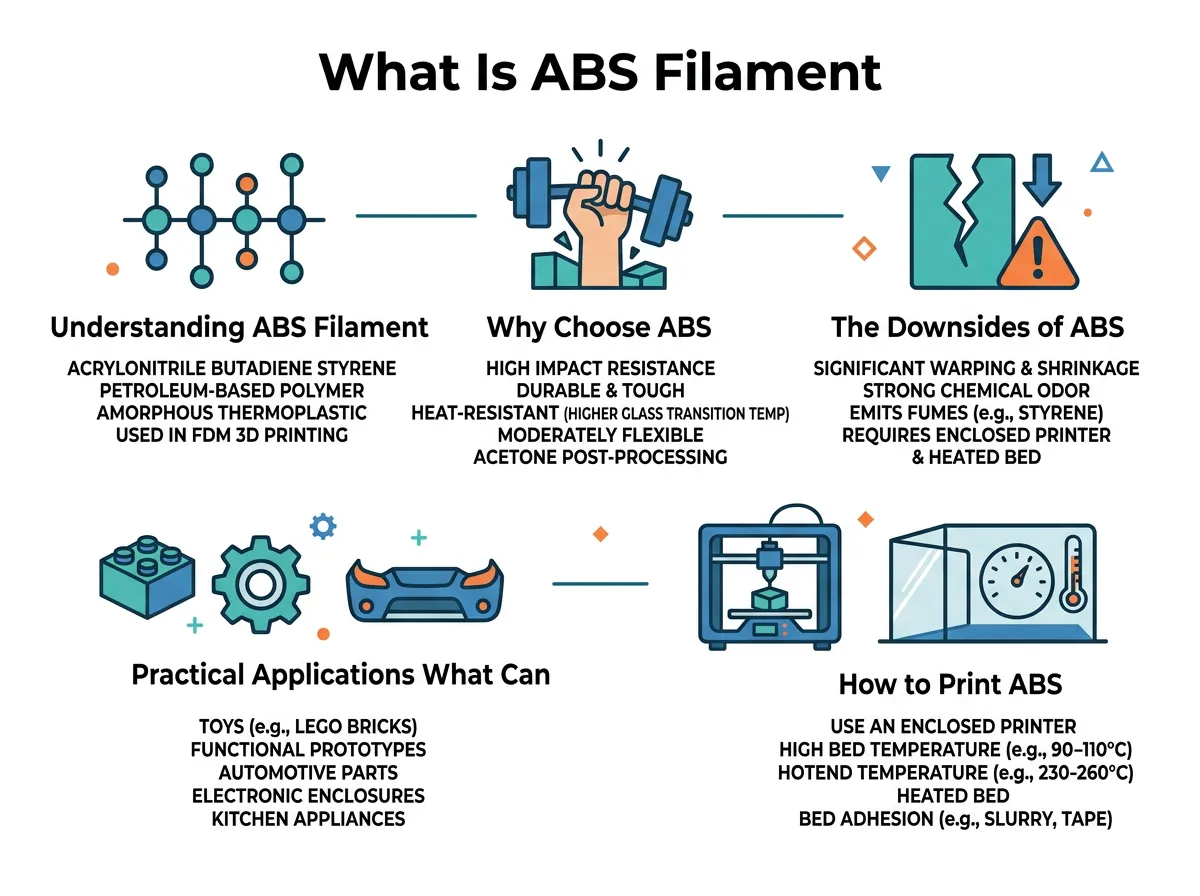
What Is ABS Filament? — key points at a glance
Unmatched Toughness
ABS is not brittle. If you drop a PLA print on a concrete floor, it might shatter. If you drop an ABS print, it will likely bounce. This makes it perfect for tools, brackets, and protective cases.
Great Heat Resistance
Most 3D prints melt or warp if left in a hot car. PLA starts to soften at just 60°C (140°F). ABS can easily handle temperatures up to 85°C (185°F) or higher before it loses its shape. This makes it a great choice for parts that go under a car hood or sit in direct sunlight.
Easy post-processing
One of the coolest things about ABS is how easy it is to finish. You can sand it down easily with normal sandpaper. Even better, you can smooth it using acetone. Acetone melts the outer layer of the print just enough to wash away all the layer lines. This leaves you with a shiny, injection-molded look.
The Downsides of ABS Filament
While ABS is incredibly strong, it is not the easiest plastic to work with. If you want to use it, you need to be prepared for a few challenges.
The dreaded warping effect
ABS shrinks as it cools down. If the layers cool too fast while printing, they will pull on each other. This causes the corners of your print to peel up from the bed. In bad cases, the layers can split apart completely mid-print. Because of this, industrial setups often use specialized chambers, which you can read about in guides like ABS filaments for 3D printers to keep temperatures stable.
Strong smell and fumes
When you melt ABS, it smells like hot plastic. It releases tiny particles and gases called VOCs (Volatile Organic Compounds). These fumes can cause headaches and are not safe to breathe over long periods. You must always print ABS in a room with open windows, or use an enclosed printer with an air filter.
Practical Applications: What Can You Make?
Since ABS is so tough, it is perfect for items that do actual work. It is not ideal for simple display models, but it shines in engineering tasks.
Functional household parts
Need a new handle for your drawer? Or a custom wall mount for your vacuum cleaner? ABS will hold up to daily pulling and pushing without breaking. It is also great for outdoor items like hose nozzles or flower pots.
Prototyping and engineering
Designers use ABS to test parts before making them in factory molds. Since it can be drilled and tapped with screws, it is perfect for testing fits. Engineers often read resources like Wevolver’s guide to ABS filament to design parts that can take heavy mechanical stress.
How to Print ABS Like a Pro
Printing with ABS filament does not have to be a nightmare. If you set up your machine correctly, you can get great prints every time. Here are the golden rules for success.
Get the temperatures right
ABS needs high heat to melt. Set your nozzle temperature between 220°C and 250°C. Your print bed must also be very hot, usually between 90°C and 110°C. This high heat keeps the bottom layer stuck firm and stops shrinking.
Use a print enclosure
A simple draft of cool air from an open door can ruin an ABS print. To stop this, use a 3D printer enclosure. This is just a box that sits over your printer. It traps the heat inside and keeps the air still. You can buy cheap fabric tents that do this job perfectly.
Turn off the cooling fan
For most plastics, a fan blows on the print to cool it quickly. For ABS, you want to turn this fan off. Let the plastic cool down as slowly as possible to prevent cracking.
Boost bed adhesion
ABS hates sticking to bare glass or metal. You should use a glue stick, hairspray, or a special PEI sheet on your print bed. You can also make “ABS slurry” by dissolving scrap ABS bits in acetone and painting it onto the bed. This acts like super glue for your print.
ABS vs. PLA vs. PETG: A Quick Comparison
Choosing between these three common plastics can be tricky. Let us break down how they compare to help you choose the right one.
PLA: The beginner king
PLA is cheap, easy to print, and does not smell. However, it is brittle and melts in hot weather. Use PLA for toys, figures, and quick drafts.
PETG: The middle ground
PETG is tough like ABS but prints almost as easily as PLA. It has decent heat resistance and does not smell. However, it is very sticky and can be stringy. Use PETG for general outdoor parts.
ABS: The heavy-duty choice
ABS is harder to print than both PLA and PETG, but it is much tougher. It handles high heat easily and can be smoothed with acetone. Use ABS for heavy-duty tools, car parts, and moving gears.
Final Thoughts on ABS Filament
ABS filament is a classic material for a reason. It bridges the gap between hobby 3D printing and industrial manufacturing. While it takes some practice to master, the rewards are well worth it. By using a heated bed, an enclosure, and proper ventilation, you can create parts that are incredibly strong and beautiful. Next time you need to print a tool that lasts, skip the PLA and give ABS a try!
Frequently Asked Questions
Can I use ABS for food-safe items?
No, ABS is not safe for contact with food or drinks. It contains toxic chemicals that can leach out, and the tiny layer lines can trap harmful bacteria.
Why is my ABS print cracking between layers?
Your print is cracking because the plastic cooled down too fast, causing the layers to shrink and split. To fix this, turn off your cooling fan and use a printer enclosure to keep the air warm.
What is the difference between ABS and ASA?
ASA is very similar to ABS but has excellent UV resistance, meaning it won’t degrade under the sun. This makes ASA better for outdoor use, while ABS is cheaper for indoor items.
Do I need a special nozzle to print ABS?
No, a standard brass nozzle works perfectly fine for printing ABS. Unlike carbon fiber, ABS is soft and will not wear down your nozzle over time.
How should I store my ABS filament?
You should store ABS in an airtight container with dry desiccant packs. ABS absorbs moisture from the air, which can cause bubbles and pops when you try to print it.
Can you recycle ABS filament?
Yes, ABS is a highly recyclable plastic, but most local recycling programs do not accept 3D prints. You can melt down your scrap ABS at home to reuse it or send it to a specialized plastic recycler.
