


3D printing technology can create an incredibly diverse range of items, spanning from simple daily household tools and customized toys to complex medical prosthetics, food, and even entire houses. By using materials like plastics, metals, ceramics, and biomaterials, this versatile manufacturing process is reshaping industries and DIY projects alike. Whether you want to print a simple phone stand or a complex aerospace part, the possibilities of what can be made are virtually endless.
Imagine having a small machine on your desk that can make almost anything. You draw a shape on your computer screen. You click print. A few hours later, you hold a real, solid object in your hand. It feels like magic, but it is just modern technology. Not long ago, only big companies could afford these machines. Today, anyone can buy one for their home.
This shift raises an exciting question for beginners and experts alike. Just how far can we push this technology? If you have ever wondered, what can be 3D printed?, you are in the right place. It goes far beyond cheap plastic toys or simple green plastic frogs.
In this article, we will take a deep dive into this amazing world. We will look at practical household items you can make today. We will also explore life-saving medical gear, custom car parts, and even giant houses. Get ready to discover how this process works and what you can build with it.
Key Takeaways
- Endless Versatility: 3D printing works with plastics, metals, food, and living cells to make almost anything.
- Everyday Utility: You can print useful home items like organizer trays, phone stands, and replacement parts easily.
- Medical Miracles: Doctors use 3D printing for custom prosthetics, dental aligners, and even organic tissue models.
- Industrial Power: Aerospace and automotive sectors use it to create lightweight, highly complex metal parts.
- Eco-Friendly Potential: It reduces waste by using only the material needed and allows local, on-demand manufacturing.
Quick Answers to Common Questions
Can you 3D print metal?
Yes, industrial 3D printers use lasers to melt metal powders like steel, titanium, and aluminum into strong parts.
Is it possible to 3D print food?
Yes, specialized printers can use food pastes like chocolate, sugar, or plant-based proteins to build edible items.
Can you 3D print a real house?
Yes, large-scale construction printers can lay down concrete to build the walls of a house in under 48 hours.
What is the easiest material to print at home?
PLA plastic is the easiest and most common material for home printing because it is safe, cheap, and simple to use.
Are 3D printed prosthetics safe to use?
Yes, they are highly effective and safe, providing low-cost, custom-fit artificial limbs for people all over the world.
📑 Table of Contents
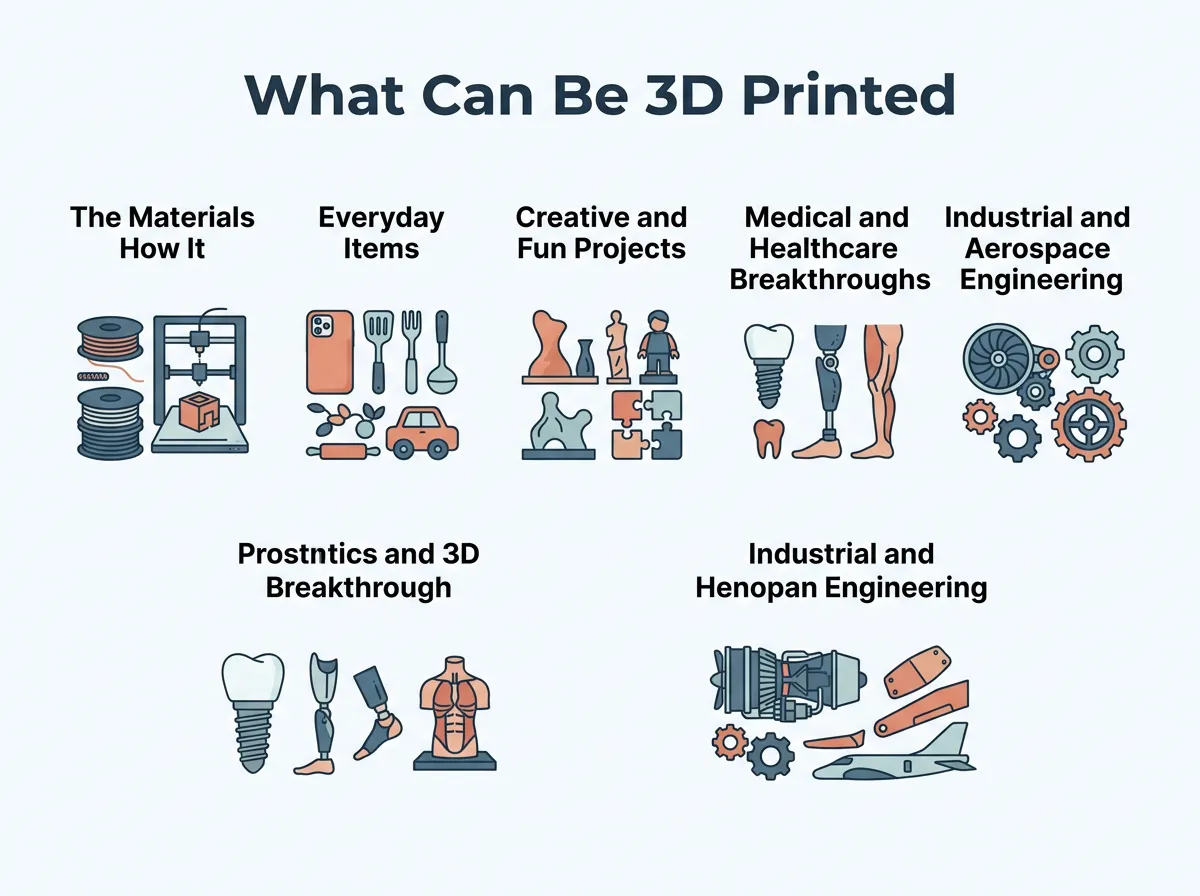
The Materials: How It All Works
To understand what can be made, we first need to look at the ingredients. Different printers use different materials to build objects. This variety is the main reason why the technology is so incredibly versatile today.
Plastics and Polymers
Plastics are the most common materials used in home printing. PLA plastic, made from cornstarch, is cheap, easy to use, and safe for beginners. This choice determines what can be 3D printed? on a budget. ABS plastic is stronger and handles heat better, making it great for car parts or outdoor gear. PETG is another favorite because it is tough and water-resistant. These materials come in spools of plastic thread called filament, which the printer melts to build your design layer by layer.
Metals, Ceramics, and Beyond
Industrial machines do not stop at plastic. They can melt metal powders like steel, titanium, and aluminum using powerful lasers. The material dictates what can be 3D printed? for tough environments. Some printers use liquid clay to make ceramic plates and bowls. Others use chocolate or sugar paste to create beautiful edible art. The type of material dictates exactly what can be made for different industry needs.
Everyday Items for Your Home
One of the best ways to start is by looking at your own house. Many people assume they need a factory to make useful things. But when you ask what can be 3D printed? for daily life, you will find hundreds of simple solutions. It is a great way to save money and customize your living space.
What Can Be 3D Printed? — key points at a glance
Smart Home Organization
Do you have messy cables behind your television? You can print custom cable clips to hold them in place. Are your kitchen drawers a mess? You can design and print custom silverware dividers that fit your exact drawer size. There are few limits to what can be 3D printed? to organize your kitchen. Many people create sturdy wall mounts for their video game controllers, headphones, or keys. You can find many useful 3D prints online that help keep your home neat and tidy. These small items only take a few hours to make and use very little plastic.
Replacement Parts and Quick Fixes
We all have that one appliance with a broken knob or a missing battery cover. Normally, you would have to throw the whole item away or buy an expensive replacement part. With a 3D printer, you can just make a new one. You can measure the broken part with a ruler, draw it on your computer, and print a perfect fit. When exploring what can be 3D printed? at home, repair parts are always a smart choice. People routinely fix dishwasher wheels, vacuum cleaner attachments, and drawer handles this way. It is good for your wallet and keeps waste out of landfills.
Creative and Fun Projects
While utility is great, sometimes you just want to have fun. The creative community is huge, and they love to share their designs. Let’s explore what can be 3D printed? when you let your imagination run wild.
Toys, Games, and Cosplay
For kids and hobbyists, a 3D printer is a dream come true. You can print custom board game pieces, puzzles, and action figures. If you love costume design, you can make highly detailed armor and props. Hobbyists love discovering what can be 3D printed? for games. Many makers share lists of cool things to print, ranging from wearable helmets to working mechanical clocks. The level of detail you can achieve at home is truly mind-blowing.
Custom Art and Home Decor
You do not have to be a professional artist to decorate your home with unique pieces. You can print beautiful geometric vases, lampshades that cast unique shadows, and wall art. You can even print lithophanes, which are 3D photos that appear when you hold them up to light. This broadens our view of what can be 3D printed? for interior design. It allows you to fill your home with personalized art that no one else has.
Medical and Healthcare Breakthroughs
The impact of this technology goes far beyond our homes. In hospitals and labs, it is saving lives and changing medicine. When looking at what can be 3D printed? in healthcare, the results are truly inspiring.
Custom Prosthetics and Orthotics
Traditional artificial limbs can cost tens of thousands of dollars. They are also heavy and hard to adjust, which is especially tough for growing children. Now, doctors and volunteers can print custom prosthetics for a fraction of the cost. Because these devices are made from digital scans, they fit the patient perfectly. This changes our idea of what can be 3D printed? to save lives. This technology makes artificial limbs accessible to people all over the world.
Dental and Surgical Guides
If you have had clear braces recently, you have already used this technology. Dentists print highly accurate models of your teeth to create custom aligners. Surgeons also use printed models of a patient’s organs to practice complex surgeries before they enter the operating room. There are many unexpected 3D printing use cases in medicine that make treatments faster, safer, and much more accurate.
Industrial and Aerospace Engineering
Big industries were the first to use 3D printing, and they still push its limits today. When we ask what can be 3D printed? in heavy industry, the answer is often metal, not plastic.
Lightweight Aircraft Components
In aerospace, every gram of weight matters. Lighter planes and rockets use less fuel, which saves money and reduces pollution. Engineers use metal 3D printers to create parts with complex hollow shapes inside. Engineers constantly test what can be 3D printed? for aerospace. These parts are just as strong as solid metal but weigh up to 50% less. Some rocket engines now have major parts printed as a single piece, reducing the risk of leaks and failures.
Rapid Prototyping in Automotive
Car manufacturers use these machines to design new vehicles much faster. Instead of waiting weeks for a factory to make a test part, engineers can print it overnight. They can test how the part fits and works the very next day. This speeds up the design process, helping companies bring safer, more efficient cars to the market quickly.
Mind-Blowing Future Frontiers
We have looked at the present, but what about the future? The technology is moving so fast that what seemed impossible yesterday is happening now.
3D Printed Houses and Buildings
Yes, you can actually print a house! Giant robotic printers use a quick-drying concrete mix to lay down walls layer by layer. These machines can build the concrete structure of a house in under 48 hours. To see what can be 3D printed? on a massive scale, look at concrete. This method reduces labor costs, cuts down on construction waste, and allows for unique curved designs. It could help build affordable housing quickly in areas hit by natural disasters.
Bioprinting Organs and Food
Scientists are working on printing living tissue. They use “bio-ink” made of human cells to print structures like blood vessels and skin grafts. The goal is to print fully working organs, like kidneys or hearts, for patients who need transplants. In the food industry, companies are even printing meat products using plant-based proteins, offering a new way to enjoy sustainable food.
Tips for Getting Started
If you want to try this yourself, starting out is easier than you think. You do not need to be a computer genius to get great results.
Choose the Right Printer
For your first printer, an FDM (filament) printer is usually the best choice. They are safe, affordable, and easy to run. Resin printers are better if you want to print tiny, highly detailed things like miniature game figures, but they require more cleanup and safety gear.
Start with Ready-Made Designs
You do not need to learn complex 3D design software right away. Websites like Thingiverse and Printables have millions of free designs you can download. You just load the design into a program called a “slicer,” which prepares the file for your printer, and you are ready to go.
Conclusion
So, what can be 3D printed? The truth is, we are only scratching the surface of what this technology can do. It started as a tool for making simple plastic models. Today, it builds houses, saves lives, and helps us explore space. Whether you are a hobbyist printing a toy or an engineer designing a rocket, this technology gives you the power to turn your ideas into reality. The only real limit is your imagination.
Frequently Asked Questions
Can a 3D printer make anything?
While 3D printers are highly versatile, they cannot make objects that require multiple moving electronic parts or mixed materials in a single step. You would need to print the parts separately and assemble them later.
What is the cheapest thing you can print?
Small plastic items like cable clips, keychains, and simple phone stands are very cheap to print, costing only a few cents in material. These are great projects for beginners to try out.
Is 3D printing hard to learn?
No, it has become very user-friendly over the years. Beginners can easily download free, ready-made designs online and start printing with just a few clicks.
Can you 3D print living organs?
Scientists are currently printing simple living tissues like skin and blood vessels. While full, complex organs are not yet ready for human transplants, the research is moving fast.
Do 3D printed parts break easily?
It depends on the material and the design of the object. While some simple plastics can be brittle, materials like ABS, PETG, and metals are incredibly strong and durable.
How long does it take to print an object?
Printing time depends on the size and detail of the object. Small items like a keychain might take 20 minutes, while larger, complex items can take 12 to 24 hours.
