


Polycarbonate (PC) is widely considered the strongest consumer-grade 3D printer filament due to its incredible impact resistance and tensile strength. For industrial applications, carbon-fiber-reinforced filaments like Nylon-CF offer unmatched rigidity and stiffness. Choosing the best option depends on whether your project requires flexibility, heat resistance, or pure structural durability.
Have you ever printed a cool 3D part, installed it on a machine, and watched it snap in half? It is a very frustrating moment. Most of us start our printing journey with PLA. PLA is great for toys, figures, and simple desk items. But what happens when you need to build something truly tough? What if you need a bracket to hold a heavy shelf, a working gear for a motor, or a tool that can take a hard drop? You quickly realize you need a material that can handle some abuse.
To build these rugged parts, you must ask yourself: what is the strongest 3D printer filament? The answer is not quite as simple as picking one single spool. “Strength” can mean many different things. In this guide, we will break down the toughest materials on the market today. We will look at how they perform under pressure, find out which ones work for your printer, and share simple tips to make your prints as strong as possible.
Key Takeaways
- Polycarbonate (PC): Offers the highest overall tensile and impact strength among standard consumer filaments.
- Carbon Fiber Composites: Provide extreme stiffness and rigidity, making parts highly resistant to bending.
- Nylon: Offers outstanding durability and flexibility, absorbing heavy impacts without shattering.
- PETG: Serves as an affordable, easy-to-print, and tough middle-ground option for everyday makers.
- Settings Matter: Print orientation, higher nozzle temperatures, and extra wall loops significantly boost part strength.
- PEEK & PEI: Represent industrial-grade materials with metal-like strength, but require high-temperature specialized hardware.
Quick Answers to Common Questions
What is the strongest 3D printer filament for home use?
Polycarbonate (PC) is the strongest standard filament for home use, offering unmatched impact resistance and tensile strength. It does, however, require a heated enclosure and high printing temperatures to print successfully.
Is Nylon stronger than PLA?
Yes, Nylon is much stronger and more durable than PLA because it is flexible and highly resistant to impacts. While PLA is stiff and brittle, Nylon can bend under load without breaking.
Does carbon fiber filament make prints stronger?
Carbon fiber filament makes prints much stiffer and more rigid, which prevents them from bending. However, it does not necessarily increase the impact strength or stop parts from breaking under heavy shock.
Is PETG strong enough for functional parts?
Yes, PETG is highly durable, impact-resistant, and weather-resistant, making it excellent for outdoor brackets and functional tools. It is also much easier to print than other high-strength materials like Nylon or Polycarbonate.
How do I make my 3D prints stronger?
You can make your prints stronger by increasing the wall count, printing at a higher nozzle temperature, and orienting the model so the physical stress does not pull the layer lines apart.
📑 Table of Contents
Understanding the Different Types of Strength
Before we look at the filaments, we need to understand what makes a plastic strong. Not all strength is the same. A material might be great at holding a heavy load but shatter if you drop it. To find the right filament, you must know what kind of stress your part will face. You can compare precise mechanical characteristics in the detailed Simplify3D properties table to see how they perform.
Tensile Strength: Resisting Pulling Forces
Tensile strength is how much pulling force a plastic can take before it breaks. Think of a rope in a game of tug-of-war. If you are printing a hook that will hang from the ceiling, you need high tensile strength. This stops the hook from stretching and tearing apart under a heavy load.
Impact Resistance: Surviving Sudden Drops
Impact resistance is the ability of a plastic to absorb a sudden shock. If you drop a phone case on concrete, it needs high impact resistance. Some very stiff plastics will shatter like glass when they hit the floor. Tougher plastics will bend slightly to absorb the hit and keep your item safe.
Flexural Strength and Stiffness: Avoiding the Bend
Flexural strength is how well a material resists bending. A stiff shelf needs high flexural strength. If a plastic is too flexible, your shelf will sag under the weight of your books. Stiffness keeps your models rigid and holds their shape under constant pressure.
The Heavy Hitters: Top Strongest Filaments
If you need pure power, these are the filaments to choose. They are the heavy hitters of the desktop 3D printing world. For those looking to push the boundaries of desktop printing, analyzing the strongest 3d printer filament options reveals that Polycarbonate frequently tops the charts.
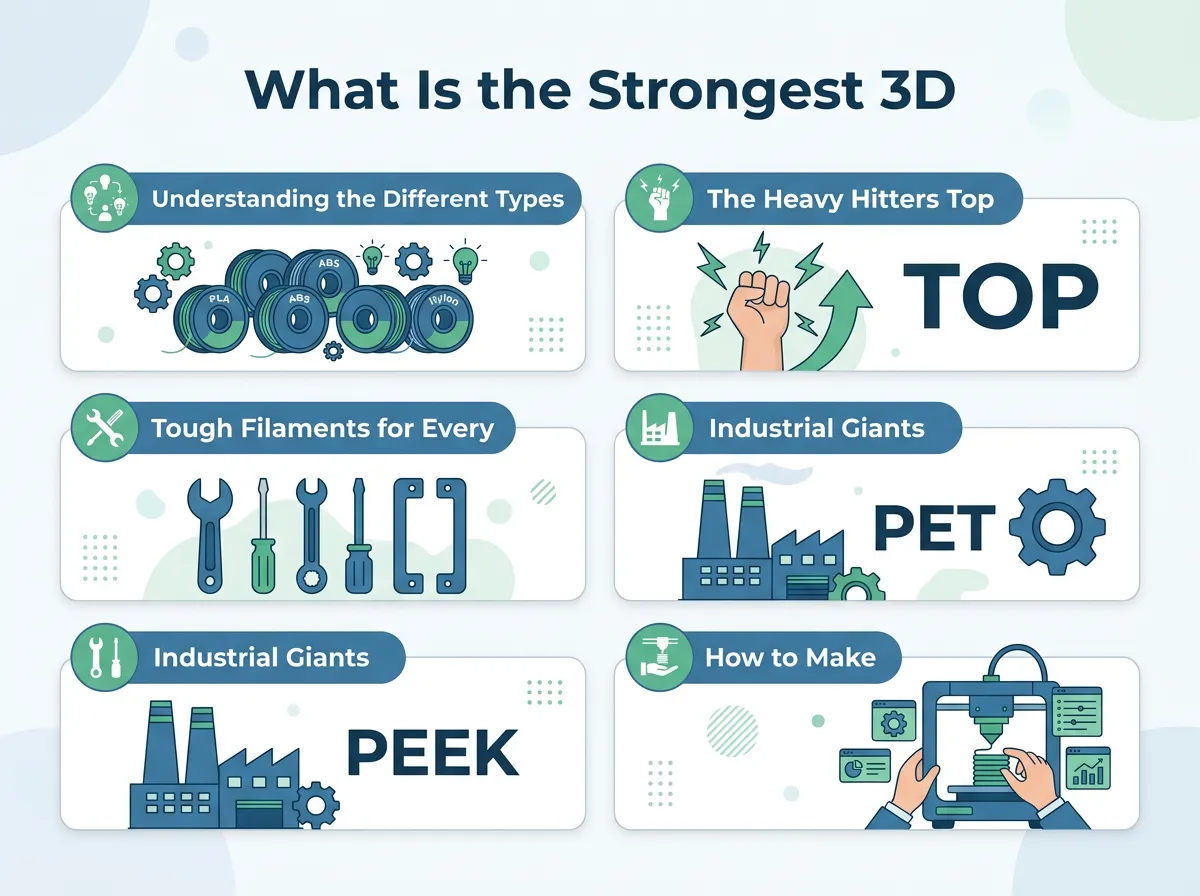
What Is the Strongest 3D Printer Filament? — key points at a glance
Polycarbonate (PC): The Undisputed King of Toughness
Polycarbonate is incredibly tough. It is the same plastic used to make bulletproof glass and safety shields. When people ask, what is the strongest 3D printer filament for desktop printers, PC is almost always the top answer. It has amazing tensile strength and can withstand very high temperatures. It can take heavy impacts without breaking. However, PC is quite hard to print. It requires a very hot nozzle, a high bed temperature, and a heated enclosure to prevent warping.
Nylon: The Flexible and Durable Champion
Nylon is a favorite for functional engineering parts. It is not as stiff as Polycarbonate, but it is incredibly durable. Nylon can bend slightly under stress and then return to its original shape. This makes it highly resistant to fatigue and impact. It is the perfect choice for gears, hinges, and RC car parts. The main challenge with Nylon is that it absorbs water from the air very quickly. You must dry the filament before you print with it, or your print will fail.
Carbon Fiber Reinforced Filaments: The Rigid Powerhouses
These are composite materials. Manufacturers mix tiny carbon fibers into plastics like Nylon, PETG, or ABS. The result is a filament that is extremely stiff and lightweight. To see how these materials rank head-to-head under heavy loads, check out the strongest 3d printer filament guide by All3DP. Carbon fiber Nylon (Nylon-CF) is a top choice for drone frames and car parts. It looks great and does not bend, but the rough fibers will wear out a standard brass nozzle. You will need a hardened steel nozzle to print it safely.
Tough Filaments for Every Budget
You do not need to spend a lot of money or buy an expensive industrial machine to get strong prints. Some excellent budget filaments offer plenty of strength for daily projects and print easily on basic machines.
PETG: The Easy-to-Print Tough Guy
PETG is the sweet spot for many makers. It is nearly as easy to print as PLA, but it is much tougher. It offers great impact resistance and stands up to outdoor weather and sun. If you want to build brackets, garden tools, or simple fixtures, PETG is a fantastic choice. It does not warp easily, and it sticks well to the print bed.
ABS and ASA: Heat-Resistant and Solid
ABS is a classic material. Lego bricks are made of ABS. It is strong, handles heat well, and you can smooth it with acetone vapor. ASA is a newer cousin of ABS. It has the same strength but resists UV light from the sun much better. Both plastics require a printer with an enclosure because they shrink and warp if they cool down too quickly during a print.
Industrial Giants: PEEK and PEI
What if you need metal-like strength? For extreme engineering, professionals turn to high-performance polymers. PEEK and PEI (often called Ultem) are at the very top of the ladder. They can handle extreme heat, harsh chemicals, and massive physical stress. They are used in airplanes, space satellites, and medical implants.
However, these materials are not meant for home use. They require specialized industrial 3D printers. Your nozzle must reach temperatures over 400 degrees Celsius, and the build chamber must be heated like an oven. These filaments are also very expensive, often costing hundreds of dollars per spool.
How to Make Your Prints Even Stronger
Choosing a strong material is only half the battle. Your print settings play a huge role in how tough your final part will be. Here are some simple, practical tips to boost the strength of your models.
Optimize Your Print Orientation
3D prints are built layer by layer. They are always weakest along the layer lines. If you pull a part in a direction that splits the layers apart, it will fail quickly. Always design and place your model on the print bed so that the forces push or pull along the layer lines, not against them.
Increase Wall Count (Perimeters)
Many people think they need 100% infill to make a part strong. In reality, adding more walls is much more effective. Adding four or five walls instead of two will make your part significantly stronger. It also saves filament and printing time compared to solid infill.
Raise the Temperature for Better Layer Bonding
Printing at the hotter end of your filament’s temperature range helps the layers melt together better. Good layer bonding is critical. If your layers do not fuse into a solid piece, your print will split easily under pressure. Turn down your cooling fan slightly to let the layers bond before they cool.
Choosing the Right Strong Filament for Your Project
When picking your material, consider your printer’s limits and your project’s environment. If you have a basic open printer and want a boost in strength, go with PETG. It is cheap and works on almost any machine. If you have an enclosure and need high impact resistance, choose Nylon or ABS. If you need maximum stiffness and have a hardened nozzle, Carbon Fiber Nylon is your best bet. Finally, if you need the absolute highest strength possible on a desktop machine, prepare your enclosure and print with Polycarbonate.
Frequently Asked Questions
Is PLA considered a strong filament?
PLA has surprisingly high tensile strength and stiffness, but it is very brittle. Under sudden impact or heavy stress, it will shatter or snap rather than bend, and it deforms easily under heat.
Why is Polycarbonate so hard to print?
Polycarbonate requires extremely high temperatures, usually between 260 and 310 degrees Celsius. It also shrinks significantly as it cools, which causes severe warping and lifting if you do not use a heated chamber.
Which filament is best for outdoor use?
ASA is the best choice for outdoor use because it is strong, heat-resistant, and highly resistant to UV rays from the sun. PETG is another great, budget-friendly option for outdoor projects.
Does infill percentage affect the strength of a 3D print?
Yes, but only up to a point. Increasing infill from 20% to 50% helps, but going all the way to 100% uses a lot of filament for very little extra strength; adding more perimeter walls is a much more efficient way to build strong parts.
What nozzle do I need for carbon fiber filaments?
You must use a hardened steel or ruby-tipped nozzle to print carbon fiber filaments. The tiny carbon fibers are highly abrasive and will quickly wear out and ruin a standard brass nozzle.
Can you print PEEK on a budget 3D printer?
No, you cannot print PEEK on a budget printer. PEEK requires nozzle temperatures above 400 degrees Celsius and a highly heated print bed and chamber, which only specialized industrial printers can provide safely.
