


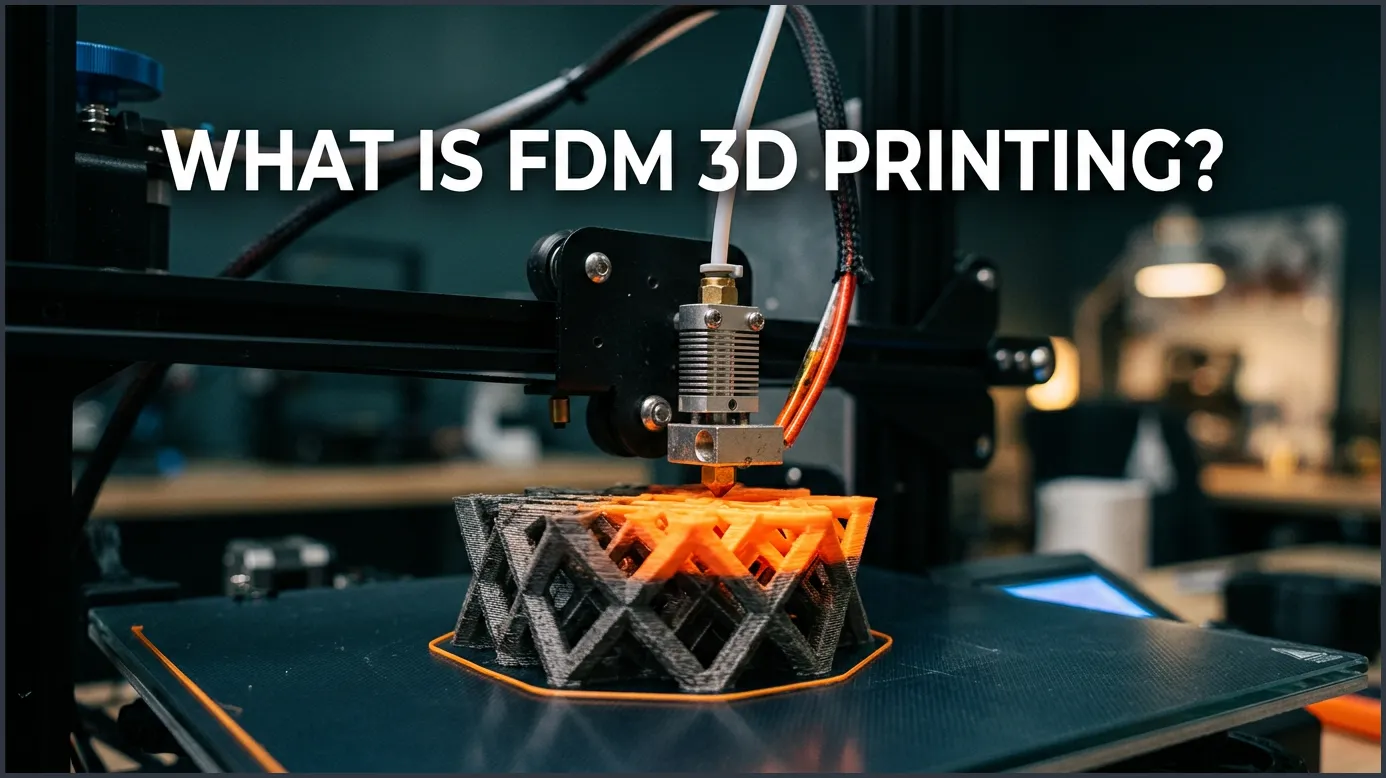
Fused Deposition Modeling (FDM) is an additive manufacturing process that builds objects layer-by-layer by melting and extruding plastic filament. It is the most common, affordable, and user-friendly type of 3D printing available today. Whether you want to make quick prototypes or fun home projects, FDM is the go-to technology for creators worldwide.
Imagine walking into a room and seeing a machine draw a physical object out of thin air. A plastic string goes in, and a custom toy, a gear system, or a spare part comes out. It looks like science fiction, but it is actually happening in millions of homes, schools, and offices around the world. The tool making this possible is right at our fingertips.
If you have ever seen a desktop 3D printer in action, you were likely watching FDM 3D printing. It is the most popular type of 3D printing on the market. But how does this technology actually work? What are the parts inside the machine, and what can you build with them?
In this guide, we will break down everything you need to know. We will look at the basic mechanics, the materials you can use, and the pros and cons of this technology. By the end of this article, you will have a clear picture of this amazing tool and how you can use it to bring your own ideas to life.
Key Takeaways
- How it works: FDM printers melt plastic filament and squeeze it through a nozzle to build objects layer by layer.
- Affordability: This is the cheapest 3D printing method, making it perfect for beginners and hobbyists.
- Material options: You can use a huge variety of plastics, including PLA, ABS, PETG, and flexible TPU.
- Strength and durability: FDM parts are tough and functional, though they have visible layer lines.
- Common uses: It is widely used for rapid prototyping, spare parts, toys, and custom jigs.
Quick Answers to Common Questions
What is the most popular material for FDM 3D printing?
PLA is the most popular material because it is cheap, very easy to print, and comes in many colors.
Is FDM 3D printing expensive?
No, FDM is the most affordable type of 3D printing, with starter printers available for under two hundred dollars.
Can FDM 3D prints be washed or exposed to water?
Yes, but it depends on the material used, with plastics like PETG being highly water-resistant and suitable for wet environments.
What is the difference between FDM and FFF?
There is no difference in the technology itself; FDM is a trademarked term by Stratasys, while FFF is the open-source name for the same process.
Can you make functional, strong parts with FDM 3D printing?
Yes, by using strong materials like PETG or ABS and optimizing your slicer settings, you can print highly durable parts.
📑 Table of Contents
The Basics of FDM 3D Printing
To fully grasp FDM 3D printing, it helps to understand its origins. The term itself tells us exactly how the process works: melting material and depositing it in a controlled way to form a shape.
What Does FDM Stand For?
FDM stands for Fused Deposition Modeling. The term was coined in the late 1980s by Scott Crump, the co-founder of Stratasys. Because the term “FDM” is trademarked, the open-source community created an alternative name: Fused Filament Fabrication (FFF). Today, both terms mean the exact same thing. You can use them interchangeably when talking about these machines.
The Core Components of an FDM Printer
An FDM 3D printing setup relies on a few key parts to get the job done. Here are the main parts you will find on almost every machine:
- The Extruder: This is the motor system that grabs the plastic filament and pushes it forward.
- The Hotend: This is the heating element. It melts the solid plastic filament so it can flow.
- The Nozzle: A small metal tip with a tiny hole. The melted plastic squeezes out of this hole.
- The Build Plate: The flat surface where the printer draws the object. This is often heated to help the plastic stick.
- The Motion System: A set of motors, belts, and rods. They move the nozzle and the build plate in three directions: X (left and right), Y (forward and backward), and Z (up and down).
How Does FDM 3D Printing Work? Step-by-Step
So, how exactly does FDM 3D printing turn a digital file into a solid plastic object? Let us look at the steps of the FDM 3D printing process.
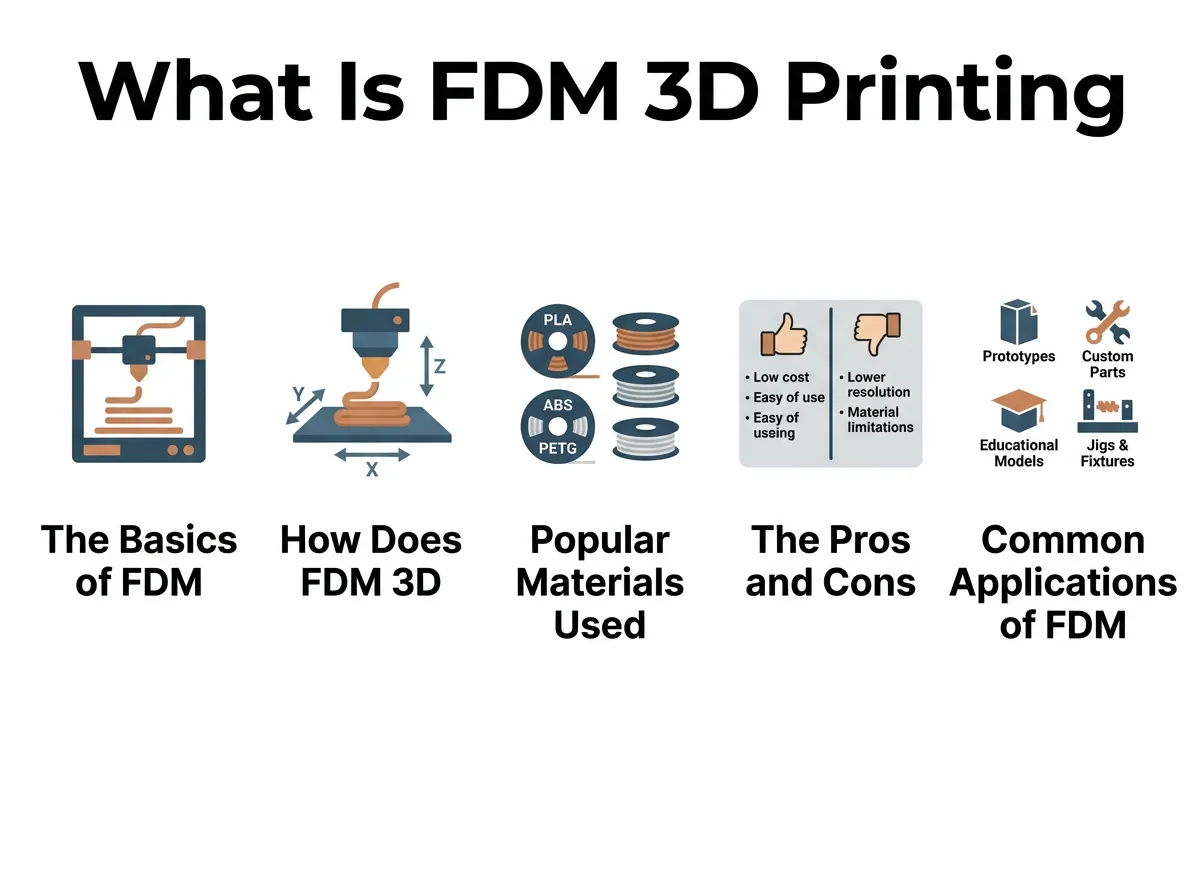
What Is FDM 3D Printing? — key points at a glance
Step 1: Designing the 3D Model
Every print starts on a computer. You need a 3D digital model of the object you want to build. You can design this yourself using Computer-Aided Design (CAD) software. If you do not know how to design, you can download pre-made designs from massive online communities.
Step 2: Slicing the Model
You cannot just send a raw 3D file straight to the printer. The printer needs a specific set of instructions. To get this, you load your 3D model into a program called a slicer. The slicer literally cuts your model into hundreds of thin, horizontal layers. It then translates these layers into a language called G-code. This code tells the machine exactly where to move, how fast to go, and how much plastic to squeeze out.
Step 3: Heating and Extruding
Once the printer receives the G-code, it starts to heat up. The hotend reaches high temperatures, often between 200 and 250 degrees Celsius. The extruder pushes the plastic filament through the hotend. As it passes through, the plastic melts instantly into a soft, paste-like state.
Step 4: Layer-by-Layer Building
The printer nozzle moves across the build plate. It draws the first layer of the object, just like a hot glue gun drawing a flat shape. Once the first layer is complete, the nozzle moves up slightly. The printer then draws the next layer on top of the first. The new warm plastic bonds with the layer below it as it cools. This cycle repeats until the final object is finished. For more detail, you can check out this comprehensive fused deposition modeling guide to see the mechanics in action.
Popular Materials Used in FDM 3D Printing
Choosing the right material is a huge part of FDM 3D printing. Most materials come on spools of thin plastic wire called filament. Let us look at the most common types.
PLA (Polylactic Acid)
PLA is the king of FDM 3D printing materials. It is made from natural sources like cornstarch, which means it is biodegradable and has a sweet smell when heated. PLA is very easy to print because it does not shrink much as it cools. This makes it perfect for beginners, toys, and simple models. However, it is brittle and melts easily under heat, so it is not ideal for outdoor use.
ABS (Acrylonitrile Butadiene Styrene)
ABS is a tough, durable plastic. It is the same plastic used to make LEGO bricks. ABS can handle high temperatures and rough wear. However, it is tricky to print. It shrinks as it cools, which can cause the edges of your print to peel up. It also releases strong, unpleasant fumes, so you need a well-ventilated space to print with it safely.
PETG (Polyethylene Terephthalate Glycol)
Think of PETG as the perfect middle ground between PLA and ABS. It is strong, flexible, and heat-resistant like ABS, but it is almost as easy to print as PLA. It is also waterproof and chemical-resistant. PETG is highly popular for functional parts and outdoor items.
Specialty Filaments
The market is full of fun, exotic filaments. You can buy flexible TPU, which prints like soft rubber. There are also filaments mixed with real wood fibers, carbon fiber, or metal powders. These allow you to make prints that look, feel, and behave like completely different materials.
The Pros and Cons of FDM 3D Printing
Like any technology, FDM 3D printing has its strengths and its weaknesses. Before investing in a printer, it is wise to compare FDM vs SLA technologies to see which one fits your project goals. SLA uses liquid resin and lasers, while FDM uses solid plastic and heat. Let us look at what makes FDM great, and where it falls short.
The Major Advantages
- Low Cost: FDM printers are the most affordable on the market. You can buy a great starter printer for under two hundred dollars. The filament is also cheap and easy to find.
- User-Friendly: The workflow is easy to learn. There are millions of online tutorials, videos, and forums to help you solve problems.
- Large Build Volumes: FDM printers can easily be scaled up. You can find large machines that let you print massive objects in one single piece.
- Safety: Most common FDM 3D printing filaments, like PLA, do not produce toxic odors. This makes FDM 3D printing ideal for homes and classrooms.
The Key Limitations
- Visible Layer Lines: Because the printer builds objects layer by layer, you will see and feel lines on the surface. FDM prints do not naturally have the smooth, injection-molded look.
- Anisotropic Strength: This means that prints are weaker along the vertical axis. The bonds between layers are never as strong as the plastic itself. If you stress a part, it will usually snap along a layer line.
- Detail Limits: FDM nozzles are usually 0.4mm wide. This means you cannot print ultra-fine details or tiny, intricate miniatures as cleanly as you could with other methods.
When you weigh the pros and cons, FDM 3D printing stands out as an excellent all-rounder. It is the best choice for everyday projects and functional prototypes.
Common Applications of FDM 3D Printing
Where do we see FDM 3D printing in the real world? From manufacturing floors to classrooms, FDM 3D printing has changed how we make things.
Rapid Prototyping
Designers and engineers use FDM to test ideas quickly. Instead of waiting weeks for a factory prototype, they can print a model overnight. If something does not fit, they change the design and print it again the next day. This speeds up the design process enormously.
Custom Household Fixes
Have you ever had a plastic bracket break on your dishwasher or a knob fall off your stove? With FDM 3D printing, you can design and print a custom replacement in a couple of hours. It is a fantastic tool for DIY home repairs.
Education and STEM
Schools use FDM printers to teach science, technology, engineering, and math. Students can design parts on a computer and see their ideas come to life. It helps teach spatial reasoning and mechanical design in a fun, hands-on way.
Tips for Getting Started with FDM 3D Printing
Starting your journey with FDM 3D printing is easier than ever. If you are ready to try it yourself, keep these simple tips in mind to ensure success.
Level Your Build Plate
The most common cause of print failure is a bed that is not level. If the nozzle is too far from the bed, the plastic will not stick. If it is too close, the plastic cannot squeeze out. Spend time getting your first layer perfect.
Store Your Filament in a Dry Place
Many 3D printing plastics absorb moisture from the air. This is called wet filament. Wet filament can lead to popping sounds during printing, poor surface quality, and weak parts. Keep your spools in airtight bags or boxes with silica gel packs.
Start with PLA
Do not jump straight into printing tough or flexible materials. Start with a simple roll of PLA. It is forgiving, reliable, and will help you learn the basic settings of your machine without frustration.
Conclusion
At its core, FDM 3D printing is about freedom. It takes manufacturing out of giant factories and puts it right on your desk. Whether you want to fix a broken tool, create custom toys, or build a prototype for a new business, this technology gives you the power to create almost anything you can imagine.
Now you know the answer to the big question: what is FDM 3D printing? With the right settings, a bit of patience, and a roll of filament, the only limit is your imagination. What will you print first?
Frequently Asked Questions
What is the difference between FDM and resin 3D printing?
FDM prints objects by melting and extruding solid plastic filament layer-by-layer. Resin printing (SLA) uses a UV laser to cure liquid resin into solid plastic. FDM is better for strong, functional parts, while resin is better for tiny details and smooth surfaces.
Is FDM 3D printing safe to use at home?
Yes, FDM printing is generally safe for home use, especially when using non-toxic materials like PLA. However, you should always print in a well-ventilated room, and use extra caution with plastics like ABS that release fumes.
How long does an FDM 3D print take?
Print time depends entirely on the size of the object and the level of detail. A small, simple coin might take fifteen minutes, while a large, highly detailed helmet can take several days. Most average-sized prints take between two and ten hours.
Can you paint FDM 3D prints?
Yes, you can easily paint FDM prints to improve their appearance and hide layer lines. It is best to sand the print first, apply a plastic-friendly primer, and then paint it with acrylic or spray paints.
Why do FDM prints sometimes warp or peel off the bed?
Warping happens when plastic cools too quickly and shrinks, pulling away from the print bed. You can prevent this by using a heated bed, applying an adhesive like glue stick, or printing inside an enclosure to keep the air warm.
Can FDM 3D printers print in multiple colors?
Yes, some FDM printers can print in multiple colors by using multi-material systems or multiple extruders. You can also pause a single-color print manually to swap filament spools and create colored layers.
