

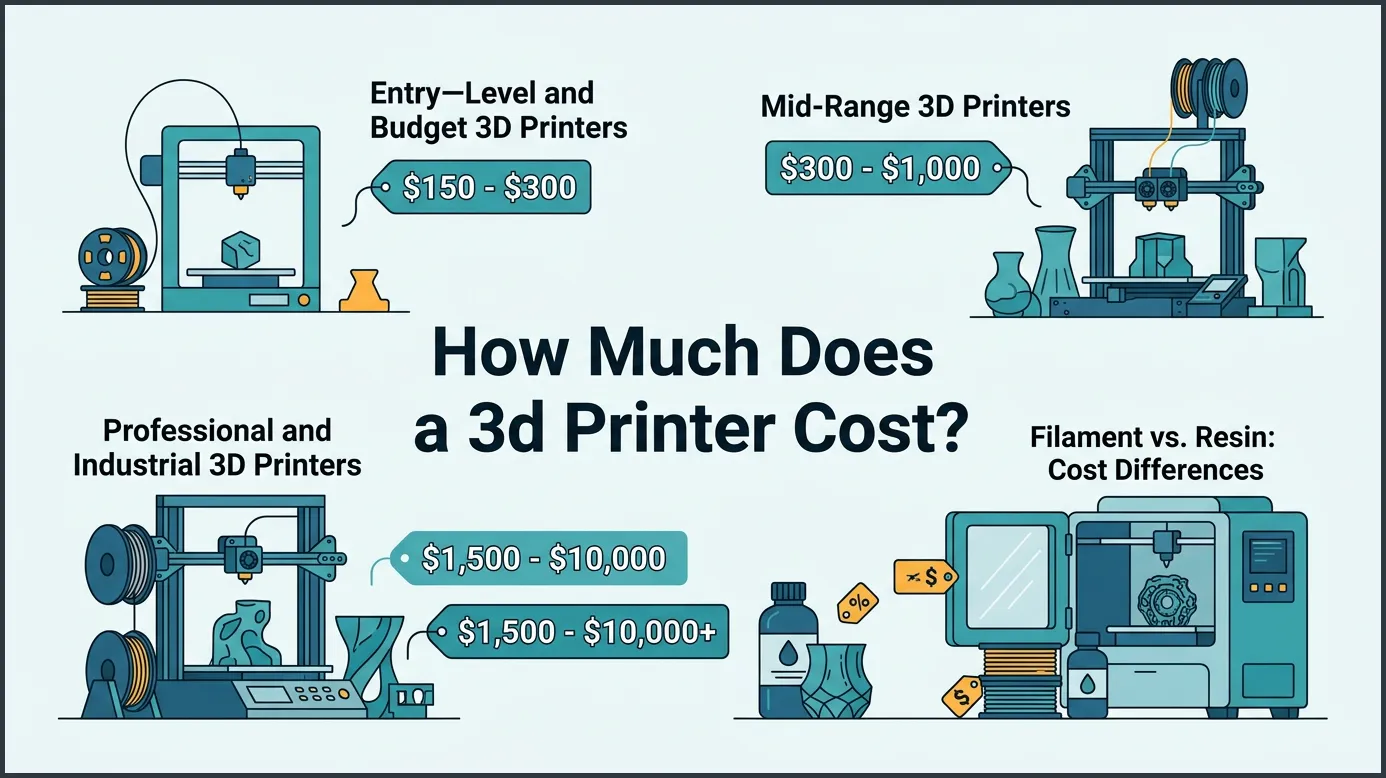
An entry-level 3D printer generally costs between $150 and $300, making it highly affordable for beginners. Mid-range models with more features cost $300 to $1,000, while professional and industrial setups range from $1,500 to over $10,000. You should also budget for ongoing costs like filament, resin, and replacement parts.
Imagine having a miniature factory sitting right on your desk. You think of an idea, design it on your computer, and watch it come to life in solid plastic. This is the magic of 3D printing. It is no longer just for big tech companies or advanced university labs. Today, anyone can start printing custom parts right from their living room.
But as you start looking at different models, you will notice something fast. The price tags are all over the place. Some machines cost less than a cheap smartphone, while others cost as much as a brand new car. If you are asking yourself how much does a 3D printer cost, you are not alone. It is easy to feel lost in all these numbers.
In this guide, we will break down the real expenses of this amazing hobby. We will look at budget machines, mid-range setups, and professional systems. We will also look at the hidden costs like materials, maintenance, and software. By the end, you will know exactly what to budget for your new project or business.
Key Takeaways
- Entry-Level Bargains: Beginners can easily find reliable starter printers for $150 to $300.
- Mid-Range Sweet Spot: Spending $300 to $1,000 gets you auto-leveling, faster speeds, and better reliability.
- Professional Tools: Enterprise and commercial machines cost between $1,500 and $10,000+ for extreme accuracy.
- Filament vs. Resin: Filament printers are cheaper to run, while resin printers offer high detail but cost more.
- Ongoing Expenses: Always budget for consumables like nozzles, build plates, and safety gear.
Quick Answers to Common Questions
Can I get a good 3D printer for under $200?
Yes, you can find highly reliable entry-level FDM printers like the Creality Ender 3 for under $200. These models require some assembly and manual calibration but produce excellent prints.
Is resin printing more expensive than filament printing?
Yes, resin printing is more expensive because of the higher cost of liquid resin and the need for washing chemicals and safety gear. The printers themselves are affordable, but the running costs are higher.
Are there any hidden costs in 3D printing?
The main hidden costs include replacement parts like nozzles and build plates, safety gear, and finishing tools. You also need to budget for printing materials like filament or resin spools.
How much electricity does a 3D printer use?
Most home 3D printers use about as much electricity as a standard desktop computer, which only adds a few cents to your power bill per print.
Do I need a computer to use a 3D printer?
Yes, you need a computer to run the slicing software that prepares your files. However, you can transfer files to the printer using an SD card or USB drive.
📑 Table of Contents
Entry-Level and Budget 3D Printers ($150 – $300)
If you are new to this hobby, you do not need to spend a fortune. Budget printers have come a long way in recent years. They are now more reliable and easier to use than ever before. You can easily find great deals on online marketplaces like Amazon 3D printers to start your journey without breaking the bank.
What You Get for This Price
In this price tier, you will mostly find Fused Deposition Modeling (FDM) printers. These machines use spools of plastic thread called filament. For around $150 to $300, you get a solid machine that can print basic toys, household tools, and simple models. Most of these machines come as kits. This means you will need to spend a few hours assembling them. It is a fun way to learn how your machine works from the inside out.
Popular Budget Examples
Brands like Creality and Anycubic dominate this price range. The Creality Ender 3 is a legendary example. It is cheap, highly customizable, and has a massive community. If you run into a problem, thousands of people online can help you fix it. The main drawback is that you have to calibrate these machines manually. This takes some patience and practice, but it is a great way to learn the ropes.
Mid-Range 3D Printers ($300 – $1,000)
If you want a smoother experience, you might want to step up. Mid-range printers offer a great balance. They combine reasonable prices with modern convenience. You spend less time fixing the machine and more time printing.
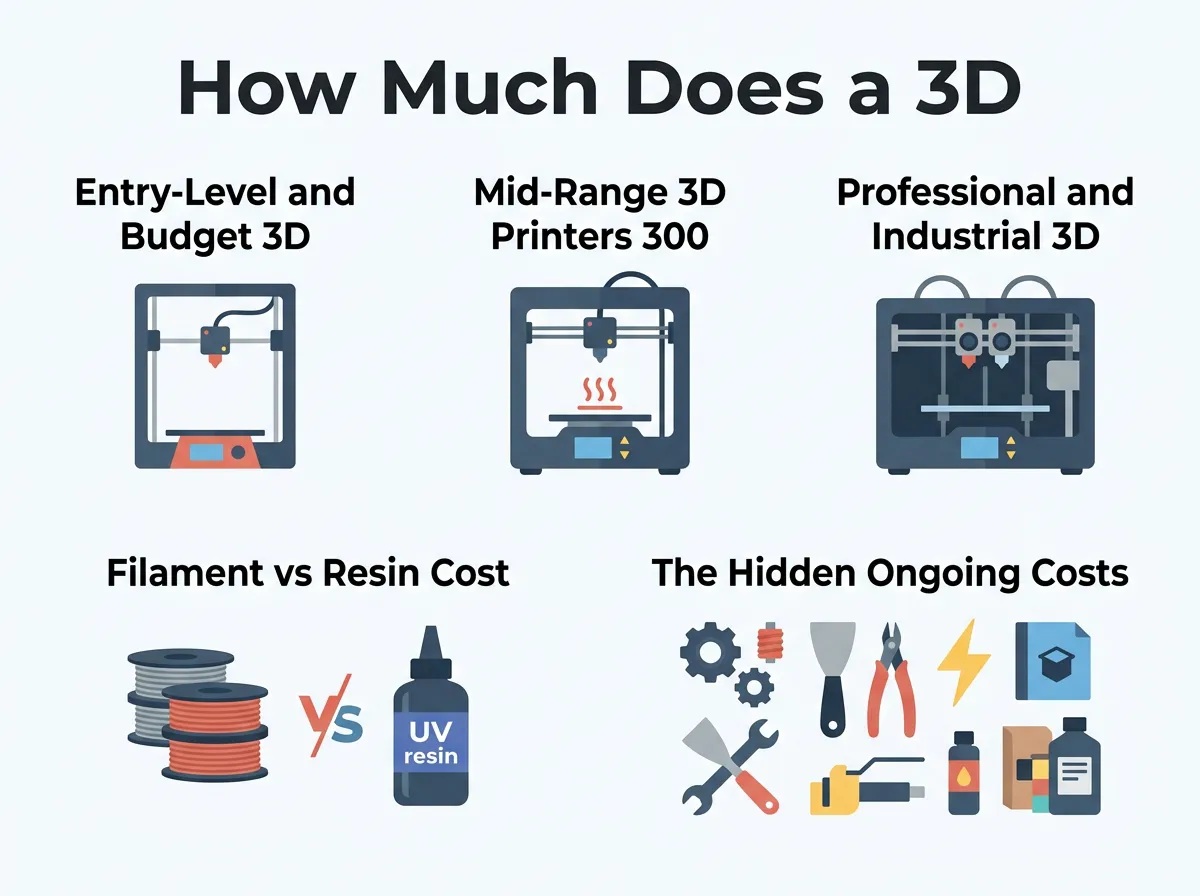
How Much Does a 3D Printer Cost? — key points at a glance
Improved Features and Reliability
What does an extra few hundred dollars buy you? It buys you auto-bed leveling. This feature alone saves hours of frustration. You also get faster print speeds, sturdier metal frames, and color touchscreens. Many mid-range printers come fully assembled. You can take them out of the box and start printing within thirty minutes. They also handle more types of plastic, like flexible TPU or strong carbon fiber filaments.
Who Should Buy Mid-Range?
This range is perfect for makers who want a reliable workhorse. If you plan to print often, the extra cost is worth it. It is also great for schools, libraries, and small workshops. When exploring how much does a 3D printer cost at this tier, you can find excellent mid-range options and compare prices on regional stores like Noon 3D printers to see what fits your space.
Professional and Industrial 3D Printers ($1,500 – $10,000+)
When we move past the $1,500 mark, we enter the professional world. These machines are built for businesses, designers, and engineers. They are made to run twenty-four hours a day, seven days a week, with very few errors.
Advanced Capabilities
Professional printers offer incredible accuracy. They can print complex parts with tiny details that budget machines simply cannot replicate. Many of these machines use SLA (Stereolithography) technology. Instead of melting plastic, they use lasers to cure liquid resin. Others use dual extruders. This lets you print with two different colors or materials at the same time. You can even use dissolvable support materials for complex, hollow shapes.
Business and Commercial Use
For businesses looking to buy high-end setups, local specialized suppliers are key. For instance, companies often check 3D printing equipment cost in Dubai to get commercial-grade hardware. These machines are serious investments. They help companies make prototypes fast. This saves thousands of dollars in design costs compared to traditional manufacturing methods.
Filament vs. Resin: Cost Differences
The type of printer you choose changes your ongoing costs. The two main types are filament (FDM) and resin (SLA) printers. Both have different price tags for their materials.
FDM (Filament) Cost Analysis
FDM printers are the cheapest to run. A standard one-kilogram spool of PLA filament costs about $20 to $30. This spool can print dozens of small models or toys. Filament is safe to handle and does not smell bad. This makes FDM the best choice for homes, bedrooms, and classrooms.
SLA (Resin) Cost Analysis
Resin printers produce stunning details, but they cost more to run. A liter of standard resin costs between $30 and $60. High-quality or engineering-grade resins can cost over $100 per liter. You also need to buy isopropyl alcohol to wash your prints. Resin is toxic before it cures, so you must wear gloves and work in a well-ventilated room. This adds safety gear to your budget.
The Hidden Ongoing Costs of 3D Printing
When asking how much does a 3D printer cost, many people forget the extra costs. Buying the printer is just the first step. You need to budget for the items that keep it running.
Materials and Consumables
Your printer has parts that wear out over time. Nozzles cost about $1 to $5 each and need replacing every few months. Print beds can get scratched and cost $15 to $40 to replace. You also need basic tools like spatulas, clippers, and glue sticks. To understand the total cost of ownership, you can read this guide on how to calculate 3D printer cost for a complete breakdown of long-term expenses.
Software and Upgrades
Most slicing software is completely free. Programs like Cura and PrusaSlicer do not cost a dime. However, professional CAD design software can require monthly subscriptions. You might also want to upgrade your printer later. Adding quiet fans or a better extruder can add another $50 to $100 to your total bill. Fortunately, home printers use very little power, so your electricity bill will barely change.
Conclusion
So, how much does a 3D printer cost in the end? The answer depends entirely on what you want to make. If you just want to have fun and print toys, a budget printer for $200 is perfect. If you want a smooth, hassle-free hobby experience, look at mid-range models around $500. For businesses and professional designers, investing in a high-end system is the way to go.
Remember to budget for your materials and spare parts too. 3D printing is an incredibly rewarding hobby and tool. By choosing the right machine for your needs, you can enjoy the magic of making your ideas real without spending more than you want to.
Frequently Asked Questions
Is 3D printing an expensive hobby?
It can be very affordable if you start with an entry-level machine and use standard PLA filament. A basic setup costs around $200, with ongoing material costs of about $20 per spool. It only becomes expensive if you upgrade to professional-grade equipment and specialized resins.
How long does a 3D printer last?
With proper maintenance and occasional part replacements, a good 3D printer can easily last for five years or more. Common parts like nozzles, belts, and fans are cheap and easy to swap out when they wear down.
Do I need to buy expensive software to design 3D models?
No, there are many excellent free options available for beginners and hobbyists. Programs like Tinkercad and Fusion 360 offer powerful design tools at no cost for personal use.
Is it cheaper to 3D print items or buy them?
For custom, hard-to-find, or replacement parts, 3D printing is often much cheaper than buying them retail. However, for mass-produced, simple plastic items, buying them in a store is usually cheaper and faster.
Can I make money with a cheap 3D printer?
Yes, many people start successful side businesses selling custom prints using budget machines. The key is finding a niche, such as custom tabletop miniatures or unique organizational tools.
Which is better for beginners, filament or resin?
Filament (FDM) printers are much better for beginners because they are cleaner, safer, and easier to use. Resin printers require handling toxic liquid chemicals and a complex post-processing wash-and-cure routine.
