


Standard 3D printer filament typically costs between $15 and $30 per 1-kilogram spool, depending on the material type and quality. High-end, specialty, or professional-grade filaments can cost anywhere from $40 to over $100 per spool. Knowing these price ranges will help you plan your budget and select the best material for your projects.
Imagine setting up your brand-new 3D printer. You are excited to start making cool toys, useful household items, or replacement parts. But before you can start printing, you need to buy plastic. You open up an online shop and get hit with dozens of options. The prices jump all over the place. You find yourself asking: how much is 3D printer filament anyway?
It is easy to feel confused by all the choices. Some spools look incredibly cheap. Others cost as much as a fancy dinner. How do you know what to buy? In this guide, we will break down the true cost of 3D printing supplies. We will look at everyday plastics, exotic options, and smart ways to save your cash.
Key Takeaways
- PLA and PETG are the most affordable options: Standard everyday filaments generally cost between $15 and $25 per kilogram spool.
- Specialty materials cost more: Flexible TPU, nylon, and glow-in-the-dark filaments range from $30 to $50 per spool.
- Engineering plastics are premium: High-performance materials like carbon fiber and polycarbonate cost between $50 and $100+ per kilogram.
- Bulk buying saves money: Purchasing filament in multi-packs can drop your price per spool down to $12 or $13.
- Quality control matters: Cheap, inconsistent filament can clog your printer nozzle, creating extra cost and hassle.
- Refills reduce costs: Buying cardboard spools or spool-less refills is cheaper and better for the environment.
Quick Answers to Common Questions
Is cheap 3D printer filament worth buying?
Cheap filament can be fine for draft prints, but it often has inconsistent thickness that can clog your nozzle. For important projects, spending a few dollars more on a reliable brand will save you time and frustration.
How many 3D prints can you get from a 1kg spool?
A standard 1-kilogram spool can print roughly 40 to 50 small miniatures or about 5 to 10 larger mechanical parts. The actual amount depends heavily on your print size, wall thickness, and infill percentage.
Does 3D printer filament expire?
Filament does not have a strict expiration date, but it degrades quickly if it absorbs moisture from the air. Storing your filament in airtight containers with desiccant packs can make it last for several years.
Why is some filament sold in 0.5kg spools?
Manufacturers often package expensive, flexible, or specialty materials in smaller 0.5kg spools to make them more affordable to buy. This also prevents customers from buying more of a niche material than they actually need.
What is the most expensive type of 3D printer filament?
The most expensive filaments are engineering-grade materials like PEEK and PEI, which can cost over $200 per kilogram. These high-performance plastics require specialized commercial printers to handle their extremely high melting temperatures.
📑 Table of Contents
The Cost of Everyday Filaments
If you are just getting started, you will likely use common materials. These are the easiest to use. They are also the most affordable options on the market today.
PLA: The Budget Champion
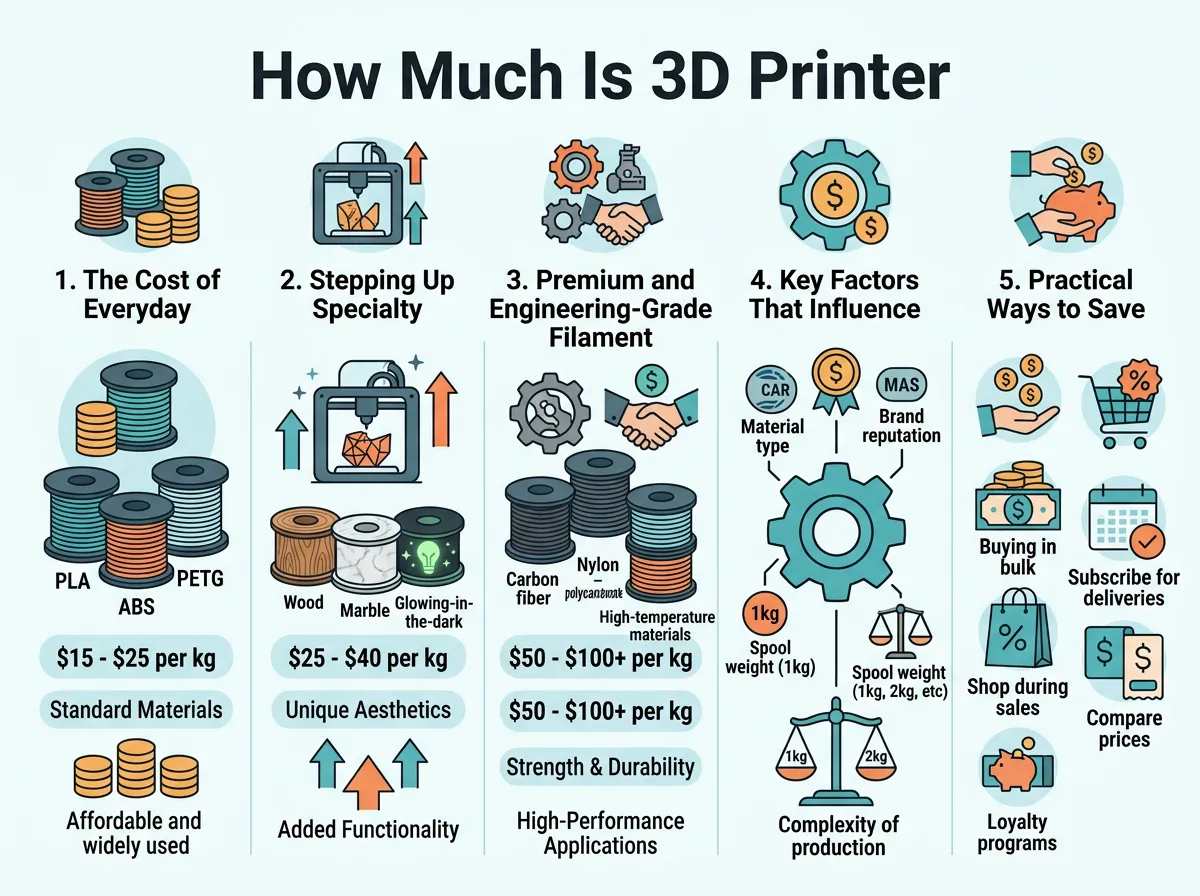
PLA is the absolute king of 3D printing. It is made from cornstarch, which means it smells sweet when it heats up. It is also very easy to print with. So, how much is 3D printer filament when buying standard PLA? Usually, you can find a good 1-kilogram spool for $15 to $22. You can browse a wide selection of these everyday materials on Amazon 3D printing materials to compare budget brands. Some generic brands go as low as $12 during online sales.
PETG: The Tough All-Rounder
PETG is like a stronger version of PLA. It resists heat and rain very well. It is perfect for outdoor brackets, plant pots, or water bottles. A 1kg spool of PETG usually costs between $18 and $25. It is only slightly more expensive than PLA, making it a great budget choice for functional parts.
ABS and ASA: The Strong Classics
ABS is the tough plastic used to make LEGO bricks. ASA is very similar, but it holds up much better in direct sunlight. Both materials are highly durable. You can expect to pay around $20 to $30 per kilogram for decent ABS or ASA. Keep in mind that these materials need a heated chamber to print well, which can add to your initial equipment costs.
Stepping Up: Specialty and Flexible Filaments
Sometimes you need prints that bend, squish, or shine. These fun materials require a bit more science to manufacture. Because of this, they carry a slightly higher price tag.
How Much Is 3D Printer Filament? — key points at a glance
TPU: Squishy and Bendy
TPU is a rubber-like plastic. You can use it to print phone cases, RC car tires, or soft shoe soles. It is highly durable and fun to use. When looking at TPU, you might wonder: how much is 3D printer filament when it stretches? TPU usually costs between $30 and $45 per kilogram. Some brands sell TPU in smaller 0.5kg spools for $20 to $25 so you do not have to buy more than you need.
Glow-in-the-Dark and Silk Filaments
Silk PLA has a shiny, metallic finish that hides layer lines. Glow-in-the-dark filament contains tiny particles that absorb light. These aesthetic filaments usually cost $25 to $35 per kilogram. Be careful with glow-in-the-dark options. Those glowing particles are very rough and can wear down cheap brass nozzles quickly.
Premium and Engineering-Grade Filament Costs
For serious makers and professionals, basic plastics do not always cut it. You might need parts that can handle extreme heat, heavy impacts, or heavy loads.
Carbon Fiber Filled Filaments
If you are working on a professional project, you might ask how much is 3D printer filament that contains carbon fiber? Carbon fiber filament is made by mixing tiny carbon fibers into PLA, PETG, or Nylon. It creates incredibly stiff, lightweight parts with a beautiful matte finish. If you want to buy these advanced materials, you can check out specialized stores like 3DJake for a massive range of options. A kilogram of carbon fiber filament usually runs from $40 to $80.
Nylon and Polycarbonate (PC)
Nylon is super slick and tough, while Polycarbonate is extremely strong and heat-resistant. These are professional materials used for gears and mechanical tools. They often cost $50 to $100 per kilogram. Some ultra-high-performance plastics, like PEEK, can cost over $200 per spool!
Key Factors That Influence Filament Prices
Not all spools are created equal. You might see two spools of white PLA that look identical, but one costs double the price of the other. Here is why that happens.
Brand Reputation and Quality Control
Top brands invest heavily in quality control. They make sure the filament diameter is exactly 1.75mm throughout the entire spool. Cheap brands might have thick or thin spots. These spots can clog your nozzle or ruin a 20-hour print. When debating how much is 3D printer filament worth spending on quality control, consider the headache of a failed print. Paying a few dollars extra for consistency is often worth it. For reliable, high-speed printing, brands like the Bambu Lab filament shop offer carefully calibrated options that ensure great results every time.
Spool Materials and Refills
Traditionally, filament comes on heavy plastic spools. Today, many brands use cardboard spools. These are better for the planet and cheaper to ship. Some companies even sell filament “refills.” You keep one plastic spool and simply slip the new filament coil onto it. This saves money and reduces waste.
Practical Ways to Save Money on Filament
If you print a lot, filament costs can add up quickly. Here are some simple, practical tips to keep your wallet happy.
Buy in Bulk
Many online shops offer discounts if you buy ten or more spools at once. If you know you use a lot of black or white PLA, buy a bulk pack. This can drop the price per spool down to $12 or $13, saving you a lot of money over time.
Watch Out for Hidden Costs
When asking how much is 3D printer filament, do not forget to factor in shipping fees. Buying a cheap $12 spool is not a deal if shipping costs $10. Look for free shipping thresholds or local pickup options. Also, keep your filament dry! Wet plastic ruins prints, leading to wasted material and money. For a deep dive into budgeting your supplies, you can read the EufyMake filament cost guide to learn more about managing your long-term printing expenses.
Wrapping Up: Finding Your Filament Sweet Spot
So, how much is 3D printer filament? For most people, the sweet spot is around $18 to $25 per kilogram. This price point gets you a reliable, easy-to-use spool of PLA or PETG that will not clog your machine. Save the expensive specialty filaments for projects that truly need them. By budgeting wisely and keeping your plastic dry, you can print amazing things without breaking the bank. Happy printing!
Frequently Asked Questions
Does the color of the filament affect its price?
Generally, basic colors like black, white, and grey cost the same. However, specialty colors like rainbow transitions, silk finishes, or glow-in-the-dark options cost a few dollars extra because they require special additives.
Is PLA filament cheaper than PETG?
Yes, PLA is usually the cheapest 3D printing filament on the market. PETG is only slightly more expensive, typically costing $2 to $5 more per kilogram, but it offers better strength and heat resistance.
How can I tell if my filament has gone bad?
Wet or degraded filament will make popping or crackling sounds as it prints. You will also notice poor bed adhesion, bubbles on the print surface, and a lot of stringing between parts.
Are cardboard filament spools cheaper than plastic ones?
Yes, cardboard spools are cheaper to manufacture and lighter to ship, which helps keep the retail price lower. They are also much easier to recycle or compost compared to traditional black plastic spools.
Can I recycle failed 3D prints back into filament?
You can recycle failed prints, but it requires an expensive home extrusion machine to grind and melt the plastic back into a spool. For most hobbyists, buying new filament is much more cost-effective than recycling it at home.
How much does it cost to 3D print a single model?
The cost of a single print is usually very low, often ranging from $0.10 to $2.00 for material. When calculating the total price, you also need to factor in a few cents of electricity and the wear on your printer.
