


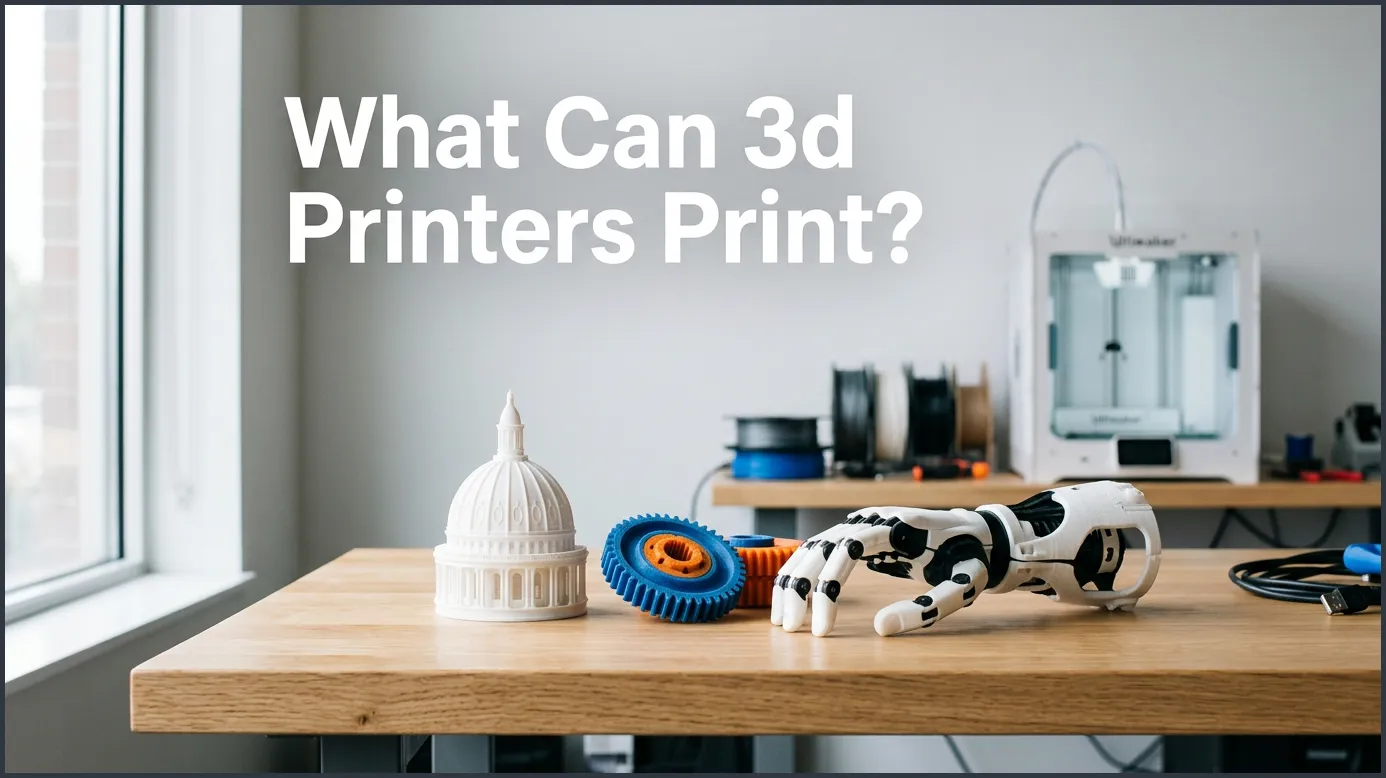
3D printers can print an astonishing variety of items, ranging from simple plastic toys and household tools to complex aerospace parts, customized medical prosthetics, and even house structures or food. Using materials like plastics, metals, ceramics, and biomaterials, these machines have revolutionized manufacturing, healthcare, and creative arts by turning digital designs into physical three-dimensional objects.
Imagine you are working on a small home project. Suddenly, you realize you need a specific, oddly shaped bracket. Years ago, you would have to drive to three different hardware stores. Today, you can simply sit down at your computer, download a design file, and press “print.” In a few hours, you hold the exact piece you need in your hand. It feels like magic, but it is just the power of modern additive manufacturing.
This technology is no longer just for high-tech labs. It sits on kitchen tables, in school classrooms, and in small workshops around the world. As these machines become more popular, many people find themselves asking: What Can 3D Printers Print? The short answer is almost anything you can imagine. From tiny plastic toys to massive concrete houses, the scope of this technology is expanding every single day. Let’s take a deep dive into the incredible world of three-dimensional printing to see what these machines can really do.
In this guide, we will explore the everyday items you can make at home, the life-saving tools used in medicine, and the massive industrial changes happening right now. We will also look at some of the most surprising things being printed today, like food and houses. In this article, we will unpack the ultimate guide to What Can 3D Printers Print? so you can see how this technology shapes our world.
Key Takeaways
- Endless Material Variety: 3D printers use plastics, metals, resins, ceramics, food, and even living cells to create physical objects.
- Practical Home Uses: You can print everyday household items like organizers, brackets, replacement knobs, and unique custom decorations.
- Medical Advancements: The medical field uses 3D printing to build highly customized bone implants, prosthetics, and dental crowns.
- Industrial Applications: Aerospace and automotive industries rely on 3D printing to create lightweight, ultra-strong components and prototypes.
- Eco-Friendly Potential: This technology reduces waste by only using the exact amount of material needed for the print.
- Accessible Tech: Desktop 3D printers have become affordable, allowing hobbyists and students to bring their own designs to life.
Quick Answers to Common Questions
Can 3D printers print metal?
Yes, industrial 3D printers use metal powders fused by high-power lasers to print strong parts from titanium, steel, and aluminum.
Can you print food with a 3D printer?
Yes, specialized food printers can extrude edible ingredients like chocolate, dough, and pureed foods into highly detailed, customized shapes.
Is it possible to 3D print a fully functional house?
Yes, large-scale construction printers use quick-drying concrete to build the walls of full-sized, livable houses in just a few days.
What is the most common material used for home 3D printing?
The most common material is PLA, a user-friendly, biodegradable plastic made from renewable resources like cornstarch.
Can 3D printers make working electronics?
While standard printers cannot, advanced multi-material printers can print conductive inks alongside plastics to create basic functional circuits.
📑 Table of Contents
Everyday Household Items and Cool Gadgets
When most people think about 3D printing, they think of the machine sitting on a hobbyist’s desk. For home users, the question of What Can 3D Printers Print? often comes down to everyday usefulness and fun. You do not need to be an engineer to make highly practical things for your home.
Smart Kitchen and Organization Hacks
Have you ever looked at a messy drawer and wished for a perfect organizer? With a home printer, you can make custom trays, cable clips, and wall mounts tailored exactly to your space. You can print chip clips, spice racks, and custom hooks to hang your towels. Many hobbyists love finding useful things to print online to solve common household problems. These small items save money and keep your living spaces neat and tidy.
Custom Home Decor and Toys
Beyond utility, these machines are fantastic for creative home decor. You can print beautiful flower vases, geometric lampshades, and unique picture frames. If you have children, the options are endless. You can make custom board game pieces, articulated toy dragons, and puzzle blocks. The ability to choose your own colors and sizes means every item matches your personal style perfectly.
Industrial and Engineering Marvels
While home printing is fun, the industrial sector is where the technology truly pushes limits. If we look at the industrial scale, What Can 3D Printers Print? They can manufacture highly complex, heavy-duty parts that are lighter and stronger than traditional parts.
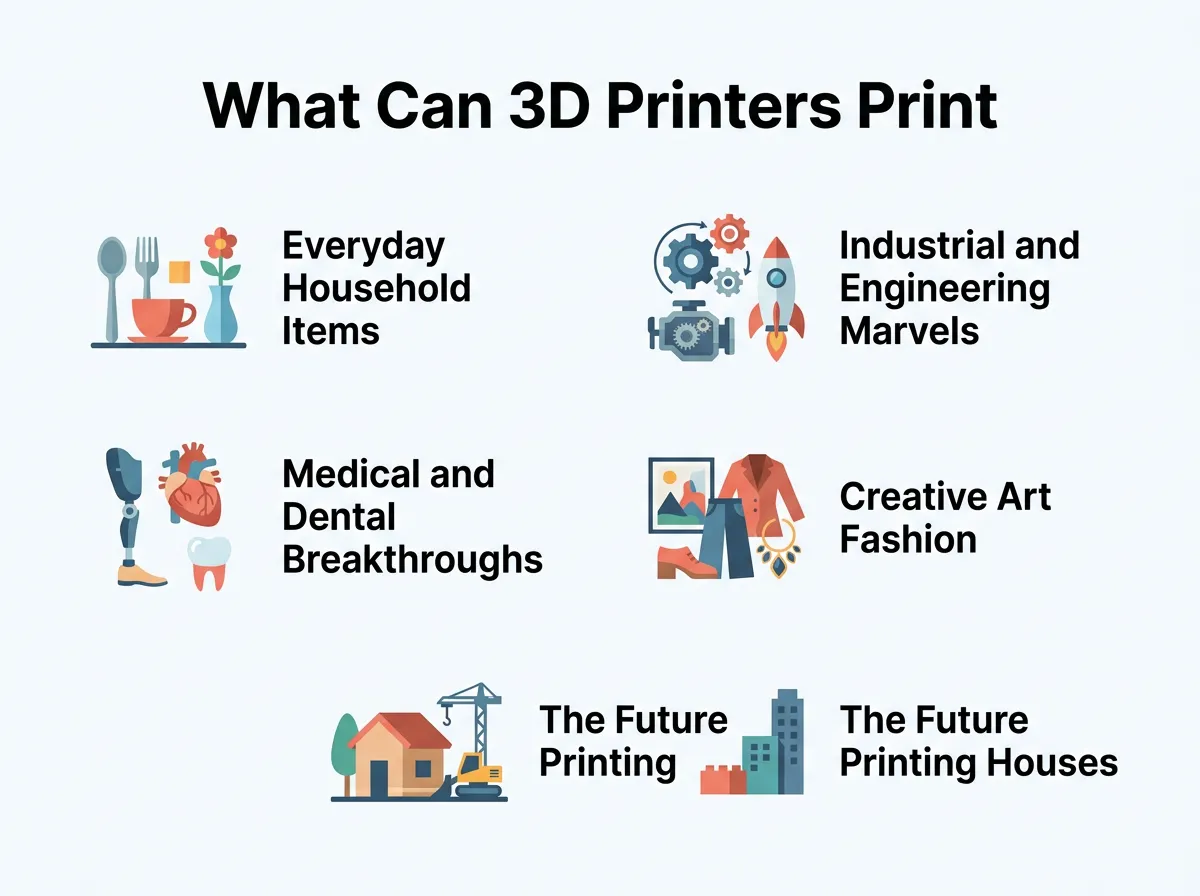
What Can 3D Printers Print? — key points at a glance
Aerospace and Automotive Parts
The aerospace industry was one of the first to adopt this technology. Rockets and airplanes need to be as light as possible to save fuel. By using advanced metal 3D printers, companies can create parts with complex, hollow internal structures. These structures are impossible to make with traditional carving or molding. Car companies also use this tech to print custom engine parts, lightweight brackets, and even entire body panels for sports cars.
Rapid Prototyping
Before a new product goes to market, engineers must test it. In the past, making a prototype took weeks and cost thousands of dollars. Now, design teams can print a physical model in a few hours. If the design has a flaw, they can fix the digital file and print a new version the very same day. This process speeds up innovation and brings safer, better products to store shelves much faster.
Medical and Dental Breakthroughs
Perhaps the most inspiring answer to What Can 3D Printers Print? lies in the medical field. Doctors and researchers are using this technology to save lives and improve patient care in ways we never thought possible.
Customized Prosthetics and Implants
Every human body is unique. Traditional prosthetics are expensive and often do not fit perfectly. Today, doctors can scan a patient’s limb and print a custom prosthetic that fits like a glove. These prosthetics can be printed in bright colors for kids, making them feel like superheroes. Surgeons also use biocompatible titanium printers to create custom skull plates and hip implants that match the patient’s exact bone structure.
Dental Solutions and Bio-printing
If you have had dental work recently, 3D printing may have played a part. Dentists use desktop machines to print highly accurate models of teeth, aligners, and temporary crowns. In research labs, scientists are even working on bio-printing. They use “bio-ink” made of living cells to print simple tissues like skin and blood vessels. The ultimate goal is to print fully functioning human organs for transplants, which could solve the organ donor shortage forever.
Creative Art, Fashion, and Design
Artists and designers are always looking for new mediums. The rise of modern printers has opened up a whole new world of creative expression, blending digital design with physical art.
Wearable Art and Clothing
High fashion has fully embraced 3D printing. Designers create stunning, avant-garde dresses, shoes, and accessories that walk the runways of Paris and New York. While we do not wear printed shirts to work just yet, flexible filaments allow for the creation of unique mesh fabrics. These fabrics bend and flow naturally with the body, creating entirely new textures.
Intricate Sculptures and Jewelry
When artists explore What Can 3D Printers Print?, they find a perfect blend of math and creativity. Sculptors use digital tools to design complex, interlocking shapes that would be impossible to carve by hand. Jewelers also benefit greatly from this tech. They print highly detailed wax models of rings and necklaces, which are then used to cast the final metal pieces. This allows for incredibly fine details and highly customized jewelry designs for clients.
The Future: Printing Houses and Food
Just when you think you have seen it all, the technology takes another leap forward. When we ask What Can 3D Printers Print? in the future, the answers sound like science fiction. We are now printing things we can live in and things we can eat.
3D Printed Homes and Buildings
Yes, you can actually print a house! Massive robotic arms use quick-drying concrete to lay down the walls of a home in a matter of days. This method is incredibly fast, reduces construction waste, and requires less labor. It offers a promising solution for affordable housing crises and quick disaster relief shelter. These printed homes are strong, well-insulated, and can be built in beautiful, curved shapes.
Culinary Creations
Food printing is another exciting frontier. Specialized printers use syringes to extrude food pastes, chocolates, and doughs. Chefs use them to create beautiful, intricate chocolate decorations that are impossible to make by hand. Researchers are also exploring personalized nutrition, where a printer can craft a meal with the exact vitamins and nutrients a specific person needs.
How to Choose the Right Materials for Your Project
To understand what these machines can make, it helps to understand the materials they use. The material determines the strength, flexibility, and appearance of the final object. To explore different machine types and the materials they handle, you can learn more about professional 3d printers and their applications.
Common Filaments for Amateurs
Most home machines use plastic filament on a spool. The most popular material is PLA, which is made from cornstarch and is very easy to print. It is great for toys, models, and simple household items. Another common material is PETG, which is stronger and heat-resistant, making it perfect for outdoor brackets and water bottles. For flexible items like phone cases or shoe soles, TPU is the go-to choice.
Advanced Resins and Powders
If you need extreme detail, resin printers are the answer. They use liquid resin cured by a light source to create smooth, highly detailed miniatures and dental models. In industrial settings, machines use fine metal or nylon powders fused together by lasers. This creates parts with incredible strength and durability, suitable for the most demanding engineering jobs. Understanding 3D printing technologies helps you choose the perfect setup for your goals.
Conclusion
The question of What Can 3D Printers Print? no longer has a simple answer. From a small plastic hook in your kitchen to a concrete home, a custom prosthetic, or a rocket engine component, this technology touches almost every part of our lives. It empowers individuals to become creators, helps doctors save lives, and allows engineers to build a better future. As materials improve and machines become cheaper, the boundaries of what we can create will continue to expand. The only real limit left is our own imagination.
Frequently Asked Questions
Is 3D printing expensive for beginners?
Not anymore. While professional industrial machines can cost thousands of dollars, a high-quality beginner desktop 3D printer can be purchased for under $200.
Can you make money with a 3D printer?
Yes, many people run successful side businesses by printing and selling custom organizers, cosplay props, jewelry, or personalized gifts on platforms like Etsy.
Are 3D printed items strong enough to be useful?
Absolutely. Depending on the material and print settings used, 3D printed items can be incredibly strong and weather-resistant, making them suitable for functional tools, brackets, and automotive parts.
How long does it take to 3D print an object?
The print time depends on the size and complexity of the object. A small coin might take 15 minutes, while a large, detailed statue could take over 24 hours to complete.
What software do I need to start 3D printing?
You will need a 3D modeling tool to design objects (or simply download free designs online) and a “slicer” software to convert the design into instructions your printer can understand.
Can you 3D print glass?
Yes, specialized high-temperature printers can print real glass by melting glass filaments or powders, though this is currently mostly used in research and artistic studios.
