


Depending on the context, TPU stands for either Thermoplastic Polyurethane, which is a highly flexible plastic used in manufacturing, or Tensor Processing Unit, which is an advanced computer chip designed by Google to run artificial intelligence programs.
Imagine you are shopping online for a new protective case for your smartphone. You see a listing that praises a material called “TPU” for its amazing shock absorption. A few hours later, you are reading a tech blog about the latest breakthroughs in artificial intelligence. Oddly enough, the writer mentions “TPU” clusters running in a massive data center. How can the same three letters refer to a bendy plastic case and a supercomputer chip?
This common mix-up happens all the time because the tech and manufacturing worlds love shortcuts. If you have ever wondered about this acronym, you are not alone. It is easy to get confused when the same term pops up in completely different industries. Today, we will clear up the confusion and explain exactly what these three letters mean in every context.
By the end of this guide, you will know how to identify both types of TPU. We will look at their unique benefits, how they are made, and where you encounter them in your daily life. Let us dive into the fascinating double life of this versatile acronym.
Key Takeaways
- Two Main Meanings: TPU can refer to either a flexible plastic material or a high-tech computer processor.
- Thermoplastic Polyurethane (Material): This type of TPU is highly flexible, durable, and commonly used to make phone cases and footwear.
- Tensor Processing Unit (Hardware): This TPU is a specialized microchip built by Google specifically to speed up artificial intelligence tasks.
- 3D Printing Powerhouse: TPU filament is highly valued in the 3D printing community for creating elastic, rubber-like parts.
- AI Engine: Google uses TPUs to power massive services like Google Search, Google Translate, and Google Photos.
Quick Answers to Common Questions
What does TPU stand for in manufacturing?
In manufacturing, TPU stands for Thermoplastic Polyurethane, a flexible and highly durable plastic.
What does TPU stand for in computing?
In computing, TPU stands for Tensor Processing Unit, a custom computer chip built by Google to accelerate artificial intelligence tasks.
Can you 3D print with TPU?
Yes, TPU is a very popular 3D printing filament used to create flexible and rubber-like parts.
Who invented the Tensor Processing Unit?
Google designed and developed the Tensor Processing Unit specifically for machine learning workloads in their data centers.
Is TPU plastic safe for daily use?
Yes, TPU plastic is non-toxic, skin-safe, and commonly used in phone cases, shoes, and medical devices.
📑 Table of Contents
The Dual Meanings: What Does TPU Stand For?
To understand this acronym, we have to split our focus into two separate industries. The term has two completely different definitions depending on whether you are talking about chemistry or computer science. Both are incredibly important to our modern world, but they share nothing in common other than their abbreviation.
On one hand, we have the physical material that makes up many of our everyday consumer goods. On the other hand, we have the invisible virtual brainpower that runs some of the most complex software on Earth. To get a complete picture, we must explore both sides of the coin. You can learn more about this dual identity in this helpful guide on what does TPU stand for and its various applications.
Understanding Thermoplastic Polyurethane (The Material)
In the physical world, TPU is a short name for Thermoplastic Polyurethane. This is a very special type of plastic. It bridges the gap between hard plastics and soft rubbers. If you have ever felt a material that is bendy like rubber but tough like plastic, you have likely touched TPU.
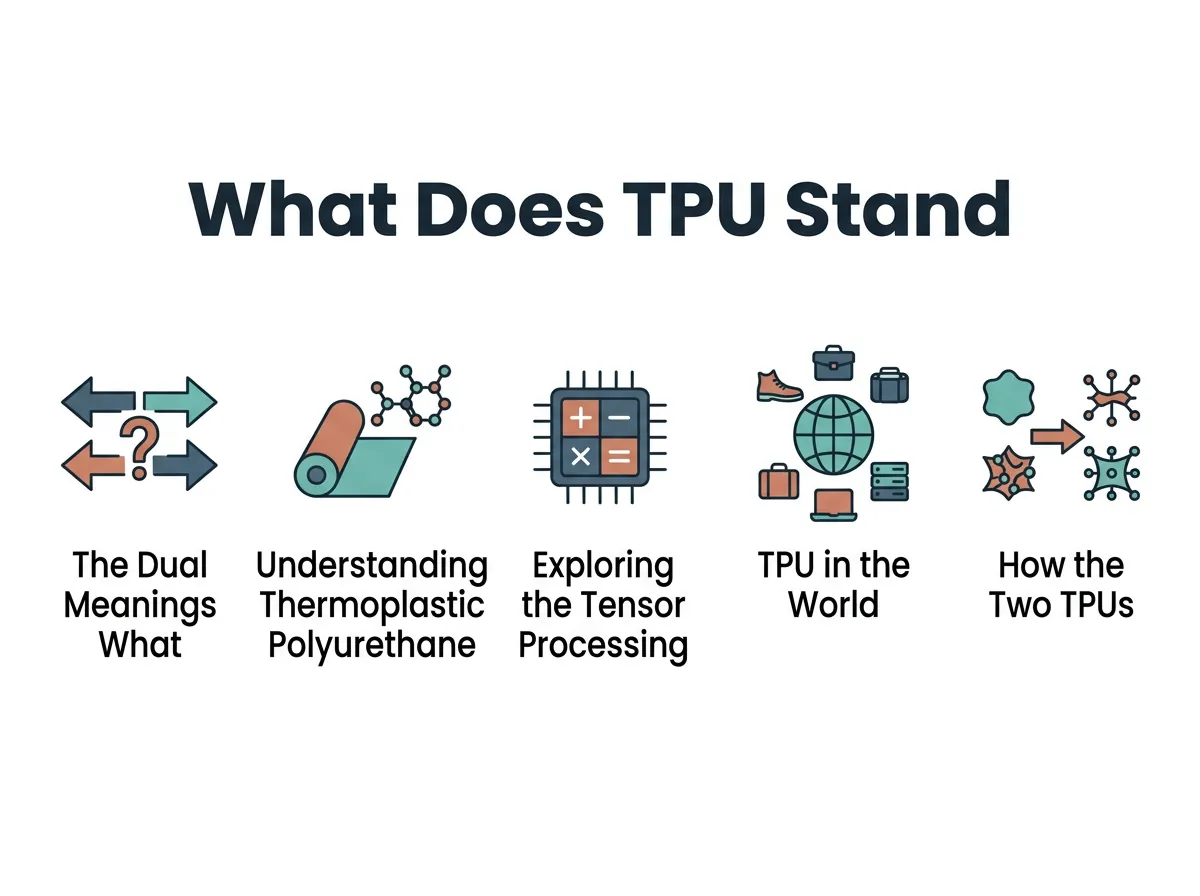
What Does TPU Stand For? — key points at a glance
Key Properties of TPU Plastic
This material is incredibly popular among manufacturers because of its unique properties. First, it is highly elastic. You can stretch it, bend it, and twist it, and it will snap back to its original shape. Second, it is very resistant to oil, grease, and scratches. This makes it perfect for items that get handled a lot, like tools or sports equipment. Finally, it can withstand both hot and cold temperatures without cracking or melting.
Everyday Uses of Thermoplastic Polyurethane
You probably interact with this plastic every single day without realizing it. It is the most common material used to make protective smartphone cases. It is also used in the soles of high-performance running shoes to absorb shock. In the medical field, it is used to make flexible tubing and devices because it is safe and durable. Even the dashboard in your car might contain a layer of this versatile plastic.
Exploring the Tensor Processing Unit (The Computer Chip)
If you leave the manufacturing plant and step into a high-tech data center, the acronym takes on a whole new meaning. In the world of technology and computing, a TPU is a Tensor Processing Unit. This is a custom-made microchip designed by Google.
Why Google Built the TPU
Computers use different chips for different tasks. Your home computer has a CPU for general tasks and a GPU for graphics and gaming. However, as artificial intelligence grew, Google realized that standard chips were too slow for complex machine learning tasks. In response, they built the Tensor Processing Unit. Google designed these chips to do one thing incredibly fast: handle the math behind neural networks.
How TPUs Power the Modern Internet
Whenever you use Google Translate, voice search, or smart photo tagging, you are likely using a TPU behind the scenes. These chips live in Google’s massive cloud data centers. They process billions of calculations per second. This allows software to understand human speech and recognize images in the blink of an eye. If you want to see how these chips fit into the broader tech landscape, Google shares a great breakdown of the difference between CPU, GPU, and TPU on their blog.
TPU in the World of 3D Printing
One place where these terms occasionally overlap in conversation is the maker movement. If you are into 3D printing, you know that finding the right material is half the battle. In this hobby, the plastic version of TPU is a superstar.
The Benefits of Flexible Filament
Most 3D printers use hard plastics like PLA or ABS. While these are great for toys and brackets, they are brittle and cannot bend. TPU filament allows makers to print flexible objects. You can use it to print custom phone cases, RC car tires, gaskets, and shoe insoles right from your desk.
Tips for Printing with TPU
Printing with this flexible material can be a bit tricky. Because the filament is soft, it can easily jam your printer’s gears. To get the best results, print at a very slow speed and use a direct-drive extruder. Keeping the filament completely dry is also crucial, as it absorbs moisture from the air very quickly. For more details on mastering this material, check out this guide on your TPU 3D printing questions answered.
How the Two TPUs Impact Your Daily Life
It is amazing to think about how these two different things shape our daily routines. One protects our physical items from drops and spills. The other powers the digital tools we use to navigate our lives. Let us look at a quick comparison to see how they affect you:
- Physical Protection: Your phone case protects your expensive device when you drop it on the concrete.
- Smart Search: Google’s chips help you find the exact photo you are looking for when you type “dog on a beach” into your search bar.
- Comfortable Steps: The foam in your running shoes cushions your joints during a morning run.
- Quick Translation: AI chips translate foreign road signs instantly through your camera lens while you travel.
Conclusion
Now you can confidently answer the question: What does TPU stand for? Depending on who you are talking to, it is either a highly durable, flexible plastic or a super-fast computer chip designed for artificial intelligence. Both technologies are quiet heroes of the modern world. One keeps our devices safe from physical damage, while the other makes our software incredibly smart. Next time you see these three letters, you will know exactly which one is being discussed!
Frequently Asked Questions
Is TPU plastic biodegradable?
Standard TPU is not highly biodegradable, but it is much more eco-friendly than traditional PVC. It can be recycled and will break down faster than conventional plastics over several decades under specific soil conditions.
Is a TPU better than a GPU for AI?
A TPU is generally faster and more efficient than a GPU for specific machine learning tasks because it is custom-built for neural networks. However, GPUs are more versatile and are still preferred for general graphics rendering and diverse computing tasks.
Does TPU turn yellow over time?
Yes, clear TPU plastic cases can turn yellow over time due to exposure to ultraviolet (UV) light and sweat from your hands. This chemical reaction is natural and permanent, though cleaning it regularly can slow the process down.
Can I use Google TPUs for my own projects?
Yes, developers can access Google’s Tensor Processing Units through Google Cloud services. This allows anyone to rent computing power to train and run their own artificial intelligence models.
Is TPU better than silicone for phone cases?
TPU is generally considered better than silicone for phone cases because it offers better drop protection and does not collect lint. It is slightly firmer than silicone, making it easier to slide in and out of your pockets.
What is the difference between TPU and PLA in 3D printing?
PLA is a stiff, easy-to-print plastic made from cornstarch that is great for beginners and decorative items. TPU is a soft, flexible, rubber-like material that is more difficult to print but perfect for functional, bendable parts.
