


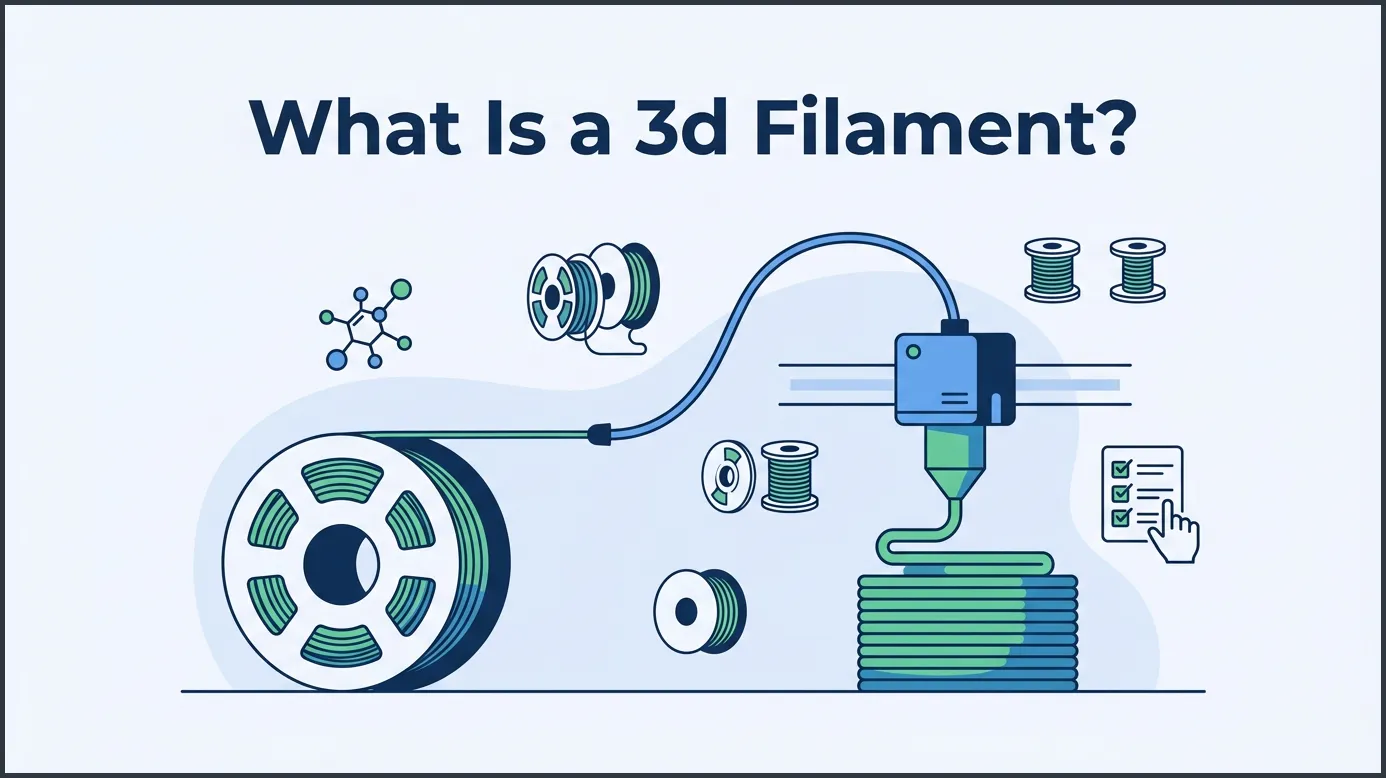
A 3D filament is the plastic thread used by Fused Deposition Modeling (FDM) 3D printers to build three-dimensional objects layer by layer. This material is wound on a spool, fed into the printer, melted at high heat, and then squeezed out of a nozzle to shape your designs. Choosing the right filament, such as PLA or PETG, determines the strength, look, and overall success of your printed parts.
Have you ever watched a 3D printer in action? It is a truly magical sight. A metal nozzle glides across a flat bed, drawing thin lines of hot plastic. Slowly but surely, a solid object appears out of thin air. You might see a small toy dinosaur, a custom phone case, or even a replacement gear for a broken clock. But what is this plastic made of, and how does it get into the printer in the first place?
To make these objects, a printer needs raw material. Just like a standard paper printer needs liquid ink, a 3D printer needs a special plastic thread. This thread is called 3D filament. In this guide, we will break down everything you need to know about this amazing material. We will look at how it works, the most popular types, and how to choose the right one for your next big project.
Key Takeaways
- The Printer’s Ink: 3D filament is the raw plastic material that feeds into FDM 3D printers to create physical objects.
- Melting Process: The printer heats the filament to a high temperature, melts it, and lays it down layer by layer.
- Two Main Sizes: Filament comes in two standard widths, which are 1.75 mm and 2.85 mm.
- Diverse Types: PLA is the easiest for beginners, while ABS and PETG offer more strength and heat resistance.
- Dry Storage Is Crucial: Plastic absorbs moisture from the air, so you must store your filament in dry, airtight bags.
Quick Answers to Common Questions
What is the most common size of 3D filament?
The most common size for home 3D printers is 1.75 mm in diameter.
Can you use hot glue gun sticks in a 3D printer?
No, hot glue sticks are too soft and have the wrong melting point for 3D printers.
Is PLA plastic safe to use around children?
Yes, PLA is made from natural starches and does not release toxic fumes when melted.
Why does my 3D filament keep snapping?
Your filament is likely old and has absorbed moisture from the air, making it brittle.
Do I need a special printer to print wood filament?
No, you can print wood filament on a standard printer, but a larger nozzle helps prevent clogs.
📑 Table of Contents
How Does 3D Filament Work?
To understand 3D filament, it helps to think of a hot glue gun. A glue gun uses a solid stick of glue. You push the stick into the back of the gun. The gun heats up, melts the glue, and squeezes it out of a small tip. As the glue cools, it gets hard again. A 3D printer works on the exact same idea, but with much more control.
Most home printers use a process called Fused Deposition Modeling, or FDM. In this system, the 3D printing filament is wound tightly onto a plastic or cardboard spool. This spool sits on a holder next to or on top of the printer. A motor pulls the plastic strand off the spool and pushes it into the print head.
The Cold End and the Hot End
The printer head has two main parts. The first part is the cold end. The cold end has gears that grip the solid filament and push it down. The second part is the hot end. The hot end has a heater block and a tiny nozzle. The nozzle is usually made of brass. When the cold end pushes the plastic into the hot end, the plastic melts instantly. The liquid plastic is then squeezed out of the tiny nozzle tip.
Building Layer by Layer
Once the melted plastic leaves the nozzle, the printer moves the head left, right, forward, and backward. It draws the first layer of your object onto a flat plate. The plastic cools and hardens almost instantly. Once the first layer is done, the printer head moves up just a tiny fraction of a millimeter. It then draws the next layer right on top of the first. The hot plastic melts slightly into the layer below it, fusing them together. This process repeats hundreds or thousands of times until your object is complete.
The Most Popular Types of 3D Filament
Not all plastics are the same. Some are stiff, some are bendy, and some can withstand high heat. Because of this, there are many different types of guide to 3D printer filament types to choose from. Let us look at the three most common materials that makers use every day.
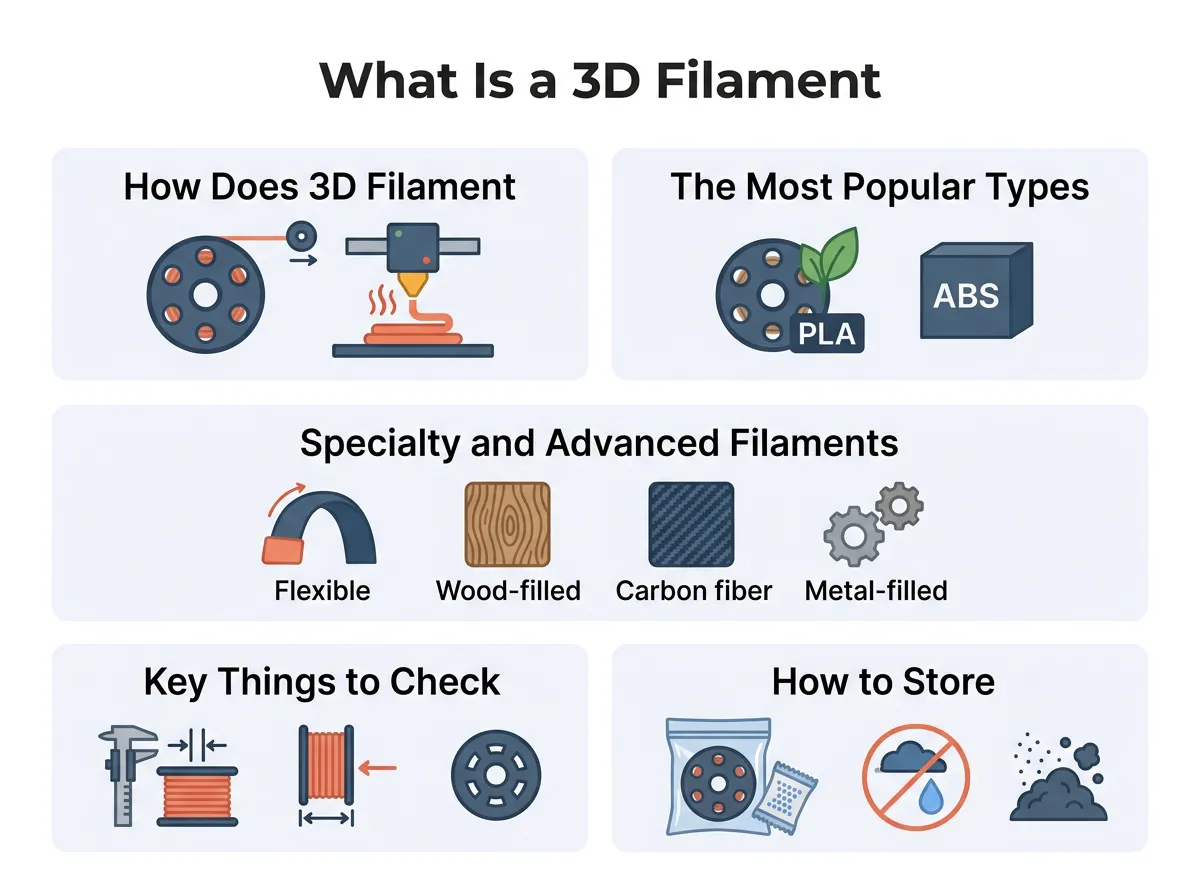
What Is a 3D Filament? — key points at a glance
PLA (Polylactic Acid)
PLA is the king of the 3D printing world. It is the most popular material for beginners and pros alike. PLA is made from natural sources like corn starch or sugar cane. Because of this, it is biodegradable and smells sweet when it melts. It does not produce toxic fumes, making it safe to use at home. PLA prints at low temperatures, usually around 200 degrees Celsius. It does not warp easily, and you do not need a heated print bed to use it. PLA is great for toys, models, and decorative items. However, it is brittle and can melt if left in a hot car.
ABS (Acrylonitrile Butadiene Styrene)
ABS is a tough, oil-based plastic. If you have ever played with Lego bricks, you have touched ABS. It is highly resistant to heat and impact. This makes it perfect for parts that need to be strong, like tools or outdoor gear. However, ABS is tricky to print. It requires a very hot nozzle and a heated print bed. It also shrinks as it cools, which can cause the edges of your print to curl up. ABS releases strong, smelly fumes when melted, so you must print with it in a well-ventilated room.
PETG (Polyethylene Terephthalate Glycol)
PETG is the perfect middle ground. It combines the ease of PLA with the strength of ABS. PETG is a modified version of the plastic used to make clear water bottles. It is strong, flexible, and highly water-resistant. PETG prints smoothly and does not smell bad. It is an excellent choice for functional parts, kitchen gadgets, and plant pots. The only downside is that PETG can be sticky, which sometimes leaves small plastic hairs on your finished print.
Specialty and Advanced Filaments
Once you master the basics, you can try exotic filaments. These materials allow you to make objects with unique properties. You can explore Raise3D’s detailed filament breakdown to see how advanced engineering plastics perform in professional settings.
TPU (Thermoplastic Polyurethane)
TPU is a flexible plastic that feels like rubber. You can bend, twist, and squeeze TPU prints without breaking them. It is highly durable and absorbs shock. People use TPU to print phone cases, RC car tires, shoe soles, and gaskets. It requires slow print speeds so the soft plastic does not jam the printer gears.
Wood and Metal Composites
Did you know you can print objects that look and feel like real wood? Wood filament is made of standard PLA mixed with real wood dust. When you print with it, your room will smell like a campfire. You can even sand and stain the finished print just like real wood. Other composite filaments contain real metal powders, like bronze, copper, or steel. These prints are heavy and can be polished to a bright, shiny metallic finish.
Key Things to Check Before Buying Filament
When you shop for a new spool of plastic, you cannot just pick any box. You must check a few key details to make sure it will work with your specific printer.
Filament Diameter
Filament comes in two standard widths. The most common size is 1.75 millimeters. Most budget and home printers use this size. The other size is 2.85 millimeters (often called 3 millimeters). Many professional printers use this thicker size. A 1.75 mm printer cannot use 2.85 mm filament, and vice versa. Always check your printer manual first.
Spool Quality and Tangling
Cheap filament often has poor winding. If the plastic is tangled on the spool, the printer will get stuck. This can ruin a print that took ten hours to make. It is always best to buy from trusted brands that wind their spools neatly.
How to Store Your Filament Properly
Plastic might look solid, but it loves water. Most 3D filaments are hygroscopic. This means they act like a sponge and absorb moisture from the air.
The Danger of Wet Filament
If your plastic gets wet, it will cause big problems during printing. The water inside the plastic will boil when it hits the hot end. You will hear popping and sizzling sounds. Your prints will have rough surfaces, weak walls, and lots of tiny holes.
Easy Dry Storage Solutions
To keep your plastic fresh, always store your spools in airtight containers. You can use large plastic bins or zip-top bags. Throw in a few packets of silica gel. These are the small paper pouches that come in new shoe boxes. They will suck any moisture out of the air and keep your plastic dry and ready for action.
Conclusion
3D filament is the fuel that brings your creative ideas to life. Whether you want to make a simple toy with PLA, a durable tool with ABS, or a bendy phone case with TPU, there is a plastic for every task. By choosing the right size, printing at the correct temperature, and keeping your spools dry, you will get amazing prints every single time. Grab a spool, load your printer, and start creating today!
Frequently Asked Questions
What is 3D filament made of?
3D filament is made of thermoplastics, which are plastics that melt when hot and solidify when cold. Common sources include plant starches for PLA and petroleum for ABS and PETG. Some filaments are also blended with wood, metal, or carbon fiber particles.
How long does a spool of 3D filament last?
A standard one-kilogram spool can last for a long time depending on the size of your prints. It is enough to print about 40 to 50 small figurines or several large structural parts. If stored in a dry place, an unopened spool can sit on a shelf for up to two years without degrading.
Why does my filament warp or curl at the bottom?
Warping happens when the plastic cools down too fast and shrinks, pulling away from the build plate. This is highly common with ABS plastic. To fix this, you should use a heated print bed, apply glue stick to the bed, or print inside an enclosed chamber.
What temperature does 3D filament melt at?
The melting temperature depends entirely on the type of plastic you are using. PLA melts at a relatively low temperature of 190 to 220 degrees Celsius. Tougher plastics like ABS and PETG require higher temperatures, usually between 230 and 260 degrees Celsius.
Can you recycle old 3D prints back into filament?
Yes, you can recycle failed prints, but it requires a special machine called a filament extruder to shred and melt the plastic back into a spool. This process can be expensive and difficult to do at home. Most hobbyists collect their scraps and send them to local recycling centers.
How do I know if my filament has gone bad?
You can tell your filament is bad if it snaps easily when you bend it with your fingers. During printing, wet filament will bubble, make popping sounds, and leave rough textures on the walls of your model. You can restore bad filament by drying it in a food dehydrator or a dedicated filament dryer.
