

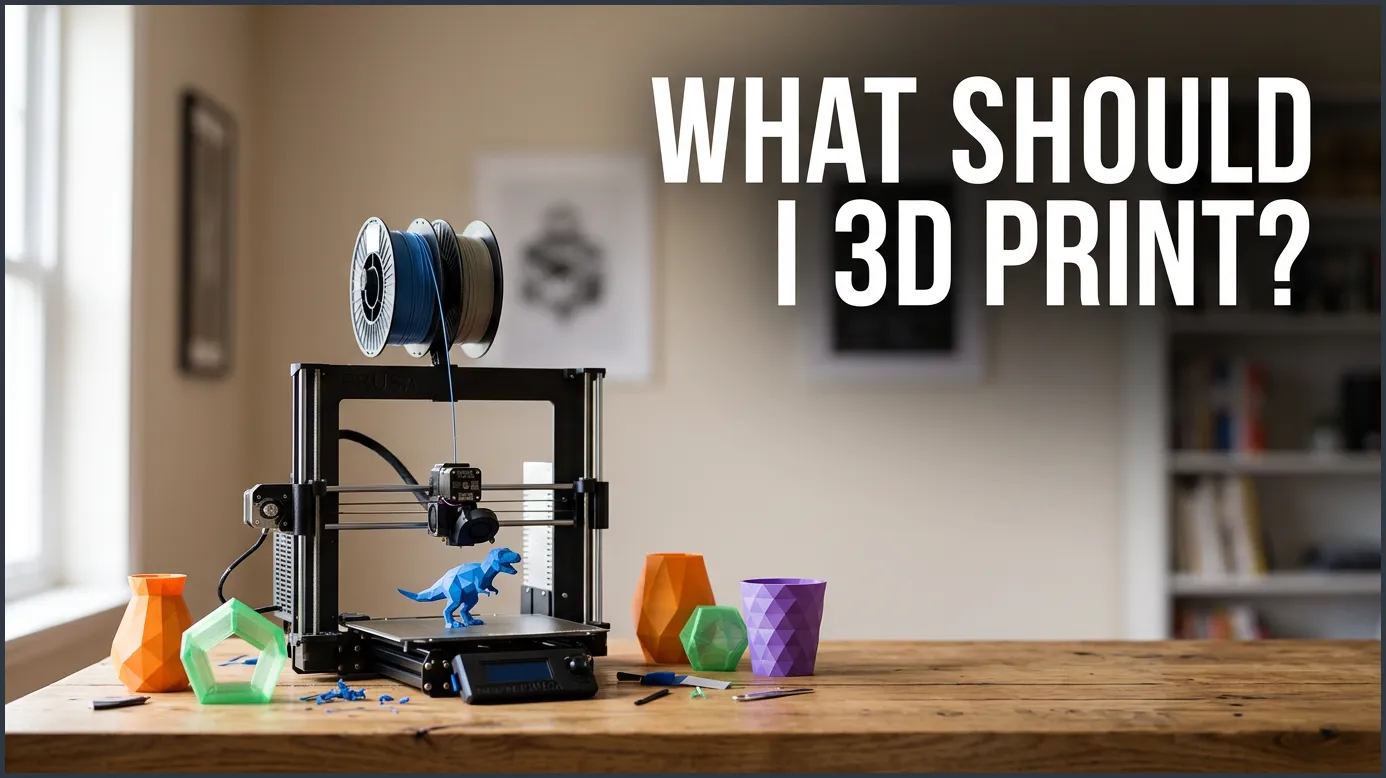
If your 3D printer is sitting idle, the best projects to start with are functional household organizers, creative tabletop toys, or custom workshop upgrades. Your choice should match your machine type, available filament, and current skill level. By starting with quick, easy-to-print models, you can test your settings and get instant, satisfying results.
You unbox your new 3D printer. You set it up, level the build plate, and watch the test print finish perfectly. But once that little plastic cat or test cube is done, the machine goes silent. You sit there, looking at an empty build plate, and wonder what to do next. It is a very common feeling that almost every maker faces.
The screen is glowing, the filament is loaded, and the possibilities seem endless. Yet, having too many choices can actually make it harder to choose. You might find yourself asking, “What Should I 3D Print?” just to kick off your making journey. It is easy to get stuck staring at digital model libraries for hours without actually starting a print.
In this guide, we will explore the best projects for your machine. We will cover functional tools, fun toys, and beautiful artistic creations. Whether you are a beginner or an experienced maker, you will find plenty of inspiration to keep your nozzle hot and your spool spinning. Let us dive into the best projects for your 3D printer.
Key Takeaways
- Start with utility: Printing functional items like cable organizers or kitchen clips provides instant value and proves your machine’s worth.
- Explore free repositories: Sites like Thingiverse and Printables offer thousands of ready-to-use models for every skill level.
- Consider material choices: Match your filament to the task, using PLA for display models and PETG or ABS for functional, durable parts.
- Embrace testing: Small calibration prints help you tune your settings before committing to massive, multi-day projects.
- Upgrade your space: Custom desk organizers, headphone stands, and tool holders are perfect weekend projects.
- Have fun with aesthetics: Flexy toys, artistic vases, and cosplay props let you showcase the visual power of 3D printing.
Quick Answers to Common Questions
What is the easiest thing to 3D print for beginners?
The easiest things to print are simple, flat-bottomed objects like phone stands, chip clips, or basic desk organizers because they do not require support material.
Which filament is best for outdoor use?
ASA and PETG are the best filaments for outdoor use because they resist UV light and can withstand higher outdoor temperatures without warping.
Where can I find free 3D models to print?
You can find thousands of free 3D models on community websites like Printables, Thingiverse, Cults3D, and MyMiniFactory.
How do I make my 3D prints look smoother?
You can smooth your prints by using lower layer heights, sanding the surface with fine-grit sandpaper, or using chemical smoothing methods like acetone for ABS prints.
Is 3D printing safe to do indoors?
Printing PLA is generally safe indoors, but it is always best to run your printer in a well-ventilated room or use an enclosure with a HEPA filter to catch ultra-fine particles.
📑 Table of Contents
Practical Solutions for Everyday Life
When you are looking at a blank build plate and thinking “What Should I 3D Print?” on a quiet afternoon, starting with utility is a great move. Making objects that solve real-world problems around your home gives you an instant sense of achievement. Plus, it is a great way to prove to your family that your new hobby is actually useful!
Kitchen and Dining Upgrades
The kitchen is full of small problems that plastic parts can solve. You can print bag clips to keep your chips fresh, custom spice racks that fit perfectly in your cabinets, or modular drawer organizers. Citrus juicers and measuring spoons are also very popular. Just make sure to research food-safe coatings if your prints will touch food directly for long periods.
Cable Management and Desk Organization
If you are asking “What Should I 3D Print?” to make your home workspace better, look at your cables. Tangled cords are a nightmare. You can find free files for under-desk cable routes, adhesive wire clips, and headphone hangers that clamp onto the side of your desk. You can find many useful 3D printer projects that will clean up your workspace in just a few hours. SD card holders, pen cups, and phone stands are also quick prints that make great gifts.
Fun and Interactive Gadgets
Every hobbyist hits a wall where they ask, “What Should I 3D Print?” to keep their kids or friends entertained. Sometimes you do not need a practical tool. Sometimes you just want something fun to play with. Toy designs have come a long way since the early days of 3D printing.
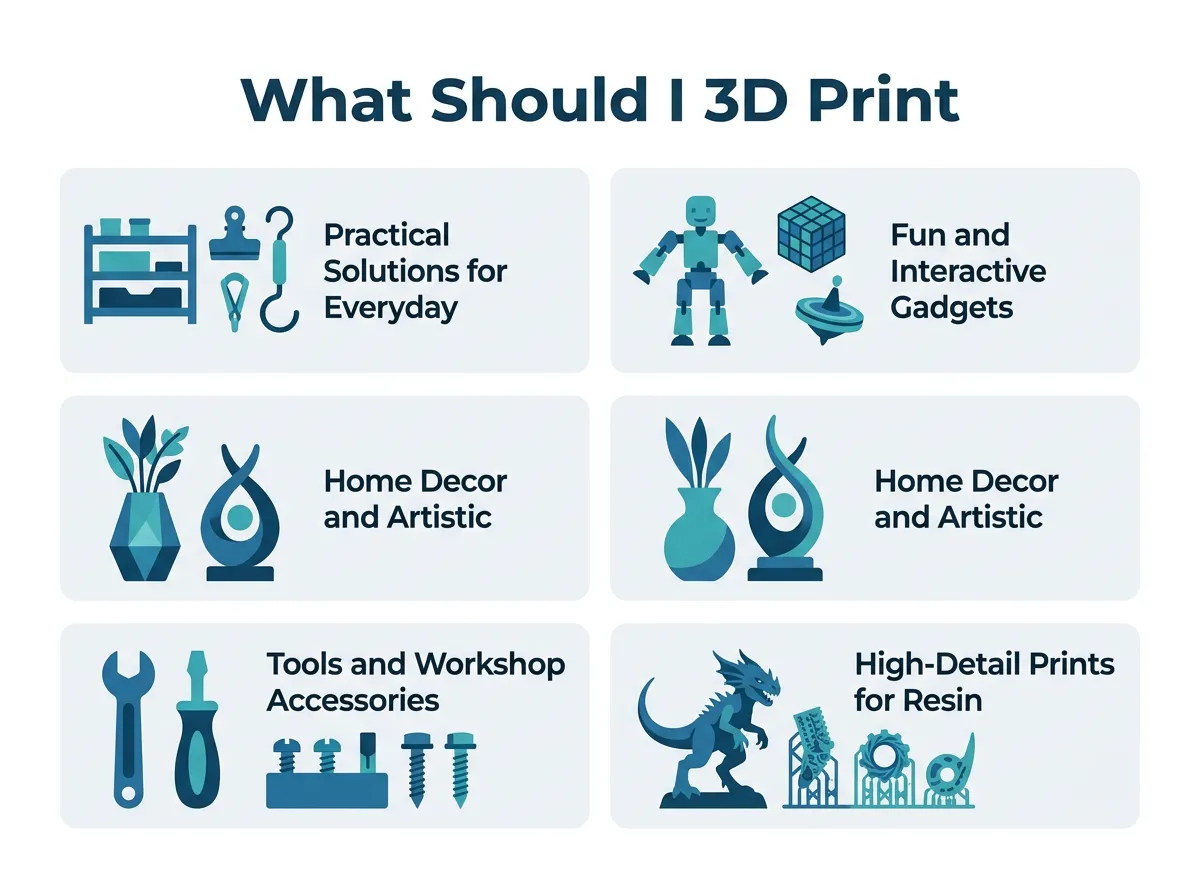
What Should I 3D Print? — key points at a glance
Articulated Toys and Fidgets
Articulated models are designed to print in one piece but have moving joints right off the bed. Flexy octopuses, dragons, and lizards are incredibly popular. They are fun to hold and make great test pieces for your printer’s retraction settings. Fidget spinners and mechanical gear cubes are also highly engaging. When kids or friends ask, “What Should I 3D Print?” these items are always crowd-pleasers.
Board Game Accessories
If you love tabletop games, your 3D printer is a goldmine. You can print custom dice towers, token trays, card holders, and miniature terrain. You can even print entire replacement pieces for games you already own. These items add a custom touch to your game nights and keep small cardboard pieces from getting lost.
Home Decor and Artistic Designs
It is easy to search the web for “What Should I 3D Print?” and get overwhelmed by thousands of design files. If you want to make your home look more stylish, you can use your printer to create beautiful art. Modern printers can handle highly detailed, organic shapes that look like they came from a high-end design store.
Beautiful Vases and Planters
Using “vase mode” (or spiralize outer contour) in your slicer is a magic trick. It prints a model using one continuous line of plastic, meaning your print finishes incredibly fast. You can make gorgeous geometric vases and light covers. Self-watering planters are another great choice. They use a two-part design that keeps your indoor plants hydrated without leaking water onto your windowsill.
Lithophanes and Light Fixtures
Wondering “What Should I 3D Print?” to beautify your room? Try a lithophane. A lithophane is a 3D-printed picture that uses different thicknesses of plastic to show an image when light shines through it. They make amazing nightlights, window hangings, or custom lamp shades. You can easily find free online tools that turn your personal family photos into printable lithophane files. To get more ideas, you can see what you can make with a 3D printer to light up your home.
Tools and Workshop Accessories
You don’t have to keep asking “What Should I 3D Print?” when your workspace is a complete mess. If you have a garage, a craft room, or a workshop, you can use your machine to organize your tools. Plastic is surprisingly strong when printed with the right settings.
Custom Tool Holders
You can print custom holders for your screwdrivers, pliers, and hex keys. The “Gridfinity” system is a very popular open-source storage standard. It uses a grid of blocks that let you arrange drawers and shelves exactly how you want. You can print custom trays for your hardware, calipers, and glue sticks so everything has its own perfect home.
Upgrades for Your 3D Printer
If you want to use your machine to improve your workspace, you might wonder, “What Should I 3D Print?” for your workshop. Why not print upgrades for the printer itself? You can print filament guides, tool drawers that slide under the printer frame, or silent fan mounts. Just make sure to print these parts in a heat-resistant material like PETG if they will be near the heated bed or hotend.
High-Detail Prints for Resin Printers
If you own an SLA or resin machine, you might ask, “What Should I 3D Print?” to show off that extreme resolution. Resin printers work differently than standard filament printers. They use UV light to cure liquid resin, which allows for incredible details that filament machines cannot match.
Miniature Figures and Tabletop Gaming
Resin printers are perfect for printing Dungeons & Dragons miniatures, anime figures, and movie replicas. The layer lines are practically invisible. You can paint these miniatures with acrylic paints to bring your favorite characters to life. You can find inspiration by looking at cool resin 3D prints online to see how far you can push your machine’s resolution.
Intricate Jewelry and Prototypes
Because resin can capture tiny details, many designers use it to print custom jewelry. You can print intricate rings, pendants, and earrings. Some resins are even castable, meaning a jeweler can use your print to make a mold for real gold or silver jewelry.
How to Choose Your Next Project
Ultimately, the question “What Should I 3D Print?” has a different answer for everyone. To help you answer “What Should I 3D Print?”, assess your current materials first. Your choice should depend on your current needs, your skill level, and the materials you have on hand.
Assess Your Filament and Material Supply
Before you start a massive print, look at your filament spool. Do you have enough plastic left? Is it the right type? PLA is great for decorative models and toys because it is easy to print. PETG and ABS are better for functional outdoor or mechanical parts because they can handle heat and stress. Flexibles like TPU are perfect for phone cases and stamps but require a well-tuned extruder.
Check Your Printer’s Calibration
If you are trying a complex print with lots of overhangs or bridges, run a quick test first. Small calibration tests like the “Benchy” boat or a temperature tower only take an hour to print. They will tell you if your printer is ready for a big project. You can browse some of the most creative community prints online to see how other makers calibrate their machines for complex designs.
Conclusion
The beauty of 3D printing is that your machine is a factory that can make almost anything. From simple chip clips that save your food to highly detailed figures that decorate your desk, the choice is yours. The next time you find yourself staring at an idle printer and asking, “What Should I 3D Print?” just pick a small, fun project and hit start. The best way to learn and have fun is simply to keep those gears turning!
Frequently Asked Questions
How do I stop my 3D prints from peeling off the bed?
To improve bed adhesion, ensure your build plate is perfectly leveled and clean it with isopropyl alcohol to remove finger oils. You can also apply a thin layer of glue stick or use a brim in your slicer settings to keep the corners down.
Is 3D printing an expensive hobby to maintain?
Once you purchase the printer, the ongoing costs are relatively low. A standard 1-kilogram spool of high-quality PLA filament costs around twenty dollars and can print dozens of small to medium-sized items.
Can I design my own 3D models for free?
Yes, there are several excellent free design programs available. Beginners can start with Tinkercad, which is web-based and easy to use, while more advanced users can download Fusion 360 or Blender for complex modeling.
What is the difference between FDM and Resin printing?
FDM printers melt plastic filament and build models layer by layer, which is great for durable, functional parts. Resin printers use light to cure liquid resin, which creates extremely detailed models with smooth surfaces, making them ideal for miniatures.
How long does a typical 3D print take to finish?
The printing time depends entirely on the size of the object and the print settings. A small coin or simple clip might take fifteen minutes, while a large, highly detailed statue can take twenty-four hours or more.
Why is my 3D printer nozzle getting clogged?
Nozzle clogs are usually caused by dust on the filament, printing at too low of a temperature, or heat creep up the hotend. Running a cleaning filament or using a small needle to clear the tip can help resolve most common blockages.
